What does this oven symbol mean?
Find it by its shape. 1. Pick what you see on the dial. 2. Match the drawing. Each of the 27 symbols here is backed by at least two makers’ own guides.
Know what you are cooking but not which setting? See what the makers recommend for 12 dishes and jobs.
Tap a shape — the symbols that use it appear here.
Straight lines — 7 symbols
 Top and bottom heat (conventional)A square with a straight line along the top and another along the…
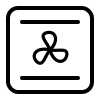 Fan with top and bottom heat (fan-assisted)A fan with a straight line above it and another below it.
 Bottom heatA square with a single straight line along the bottom and nothing…
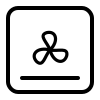 Fan with bottom heat (pizza setting)A fan with a single straight line below it and nothing above.…
 Intensive heat (top heat and stronger bottom heat)One line at the top and two lines at the bottom.
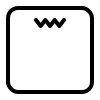
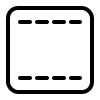 Slow cookDashed lines at the top and bottom (Bosch, Siemens; Neff adds a…
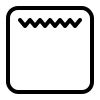
 Top heat only (browning element)A square with a single straight line along the top and nothing…
A fan — 5 symbols
 Fan oven (hot air, true fan)A fan — three curved blades round a hub — usually inside a circle,…Fan with top and bottom heat (fan-assisted)A fan with a straight line above it and another below it.Fan with bottom heat (pizza setting)A fan with a single straight line below it and nothing above.…
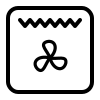 Fan grill (turbo grill, hot-air grilling)A zigzag along the top with a fan below it.
 Eco fan (hot air eco, eco convection)A fan, usually in a circle, with “eco” (Bosch, Samsung) or a small…
Zigzag — 3 symbols
Snowflake — 1 symbol
Plates or bowl — 4 symbols
 Plate warming (stacked plates)Two or three plates or dishes stacked one above another.
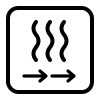
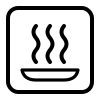 Keep warm (heat lines)Wavy heat lines rising over a dish (Bosch), three wavy lines on…
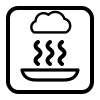 Reheat (dish with heat or steam)A dish with heat or steam rising from it. Bosch adds a steam cloud…
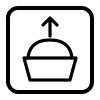 Dough proving (rising bowl)A bowl with dough domed above the rim, often with an arrow…
Wavy lines — 3 symbols
Cloud or drop — 3 symbols


Pizza or bread — 2 symbols
Grid of dots — 1 symbol
Letters — 2 symbols
Light bulb — 1 symbol

Key or padlock — 1 symbol

Clock or bell — 2 symbols


Which setting for what you are cooking
What the makers themselves recommend, quoted word for word from their own guides. A dish is listed only when a maker’s guide names it; where makers disagree, every one of them is shown. Temperatures and shelf positions vary by model, so take those from your oven’s manual.
| You are cooking | Setting | Who says so |
|---|---|---|
| Cakes on one shelf |
The makers disagree here: Siemens points to fan-free top and bottom heat, Samsung to the fan with bottom heat. Your manual’s baking table settles it for your oven. | |
| Baking or roasting on two or more shelves at once |
AEG says not to do this on conventional top and bottom heat: “An additional level would block the heat”. | |
| Pizza |
Three makers, three different settings, all aimed at a crisp base: Bosch has a dedicated pizza mode, Neff uses the fan with bottom heat, and Samsung switches to bottom heat only at the end to brown the base. | |
| Bread |
| |
| A roast joint or a whole chicken |
AEG and Siemens send large joints to the fan grill; Smeg’s guide names fan-free top and bottom heat for roasting meat. | |
| Grilling steaks or sausages, or toasting bread |
Full grill for a trayful; the centre (half) grill for one or two portions, placed right under the middle. | |
| Gratin, lasagne or browning the top |
Some AEG ovens also have a separate Au gratin mode for lasagne and potato gratin; its symbol is not on this site yet because only one maker’s guide shows it. | |
| A soggy pastry base, quiche or tart |
| |
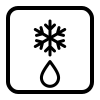
| Defrosting frozen food |
| |
| Keeping a cooked dish warm |
Hotpoint puts this job on its plate-warming symbol; Siemens and AEG have a separate keep-warm mode. | |
| Warming plates |
| |
| Slow cooking a casserole or stew |
|
Symbols by oven brand
The same drawing can carry a different name, or a different job, on each make. These pages list only the symbols that brand’s own manual or support page shows, with the brand’s name for each mode next to ours:
All 18 oven brands on one page, with the maker’s document behind each.
A code on the display instead of a symbol?
Error codes are not symbols and are not standardised: each maker numbers its own, and the same code can mean different things on two makes. These pages list the codes each maker states in its own manual or support pages, with what to check and when to call a technician:
Look up an oven code by brand, or see which makes have no page and why.
Before you trust any chart, including this one
No single published standard defines oven function icons. Each maker draws its own, which is why every meaning on this page is taken from manufacturers’ manuals and support pages, and why the same drawing can mean different things on different brands.
- Lines are heating elements. A line at the top is the element in the roof, a line at the bottom the one under the floor. Two lines with nothing between them is conventional heat.
- A fan means moving air. On its own (often in a circle) it is the fan oven; with a line above or below, the fan is spreading that element’s heat.
- A zigzag is the grill. How many zigzags and how long they are changes by brand: see Full grill.
- Fan temperatures. Recipes written for conventional (top and bottom) heat are usually set about 20 °C lower on the fan setting: AEG’s guide says to set True Fan 20 °C lower than Conventional cooking, and CATA’s conversion chart turns 180 °C conventional into 160 °C fan. Leave the time as written and check a little early.
Fan temperature sources: AEG (checked 2026-09-23), CATA (checked 2026-09-23).
Recipe temperature to fan oven
A recipe written for conventional (top and bottom) heat goes on the fan setting 20 °C lower (36 °F lower), with the cooking time left as written. If the recipe already gives a fan temperature, set that number as printed. Going the other way, a fan recipe cooked on conventional heat needs 20 °C more.
°F is worked out as °C × 9/5 + 32 and rounded to the nearest 5.
| Recipe °C | Recipe °F | Gas mark | Fan °C | Fan °F |
|---|---|---|---|---|
| 140 | 285 | 1 | 120 | 250 |
| 150 | 300 | 2 | 130 | 265 |
| 160 | 320 | 3 | 140 | 285 |
| 170 | 340 | — | 150 | 300 |
| 180 | 355 | 4 | 160 | 320 |
| 190 | 375 | 5 | 170 | 340 |
| 200 | 390 | 6 | 180 | 355 |
| 210 | 410 | — | 190 | 375 |
| 220 | 430 | 7 | 200 | 390 |
| 230 | 445 | 8 | 210 | 410 |
| 240 | 465 | 9 | 220 | 430 |
Gas marks are copied from CATA’s chart (checked 2026-11-09), which pairs each mark with a conventional temperature. It has no row for 170 °C or 210 °C, so those cells show “—” rather than a guess. A gas mark is a conventional setting: a gas oven has no fan, so there is no “fan gas mark”. CATA’s chart also prints the rounded °F that recipes tend to use (275 °F beside 140 °C, 350 °F beside 180 °C); the °F columns here are the exact formula rounded to 5, so they can differ from CATA’s by up to 10 °F, about 5 °C.
Where the rule stops: AEG gives the 20 °C figure for its True Fan mode. For other fan modes, such as fan with top and bottom heat or eco fan, take the temperature from your oven’s manual. CATA adds that you can instead keep the recipe temperature and cut the time by roughly 10 percent, but never do both, and that if results keep coming out too dark or too pale, check the oven with a separate thermometer.
- AEG: AEG UK support — Symbols and functions on your AEG oven or cooker — “True Fan cooking … Recommended use: Set the temperature 20ºC lower than Conventional cooking.” Checked 2026-09-23.
- CATA: CATA Appliances UK — Fan oven temperature conversion chart: the 20°C rule — “Subtract 20°C for a fan oven … 180°C becomes 160°C fan”; drop the temperature by 20 °C and leave the cooking time as written. Checked 2026-09-23.
What this page cannot do
- It does not cover microwave or hob icons — only the functions of an oven cavity and its controls. Those have their own pages: hob symbols (H, P, the padlock, pause) and microwave symbols (power levels, defrost, grill and combi).
- It does not identify a specific oven model. It tells you what a drawing means on the makes cited (AEG, Beko, Belling, Blomberg, Bosch, CDA, Caple, Fisher & Paykel, Gorenje, Hoover, Hotpoint, LG, Lamona, Miele, Montpellier, Neff, Rangemaster, Samsung, Siemens, Smeg, Stoves); your model’s manual says exactly which elements run and how hot.
- Left out until a second maker’s own page shows the same drawing with the same meaning (each re-checked on 2026-10-16):
- Air fry. Three makers draw it three ways: Hotpoint’s guide describes a fan above a basket, Miele’s AirFry is a fan inside two circling arrows, and Gorenje lists air fry under Intensive baking, drawn as a fan in a circle under a top line. No two match, so no drawing can be called the air fry symbol.
- Rotisserie (turnspit). Of the makers’ documents checked, only Caple’s C2601 manual draws a rotisserie symbol (two bracket marks between a top and a bottom line); no second maker’s own page or manual we could fetch shows one.
- Hydrolytic cleaning such as Gorenje’s Aqua Clean. The job, water in a tray heated to loosen dirt, is the one on Steam cleaning; Gorenje’s own drawing (an open oven with a sparkle) appears in no second maker’s document checked.
- Moist fan (AEG and Zanussi) and coolStart (Siemens): each comes from one maker group only, and a group counts as one maker.
- Grill with bottom heat. Neff’s guide describes it (a zigzag at the top and a straight line at the bottom); Hotpoint’s guide has a heading with that name but no description under it, so it does not confirm the drawing.
Sources
Every page below is a maker’s own guide or support page, fetched and checked on the date shown. Each symbol page lists what its sources show.
- Neff: NEFF UK — Oven symbols explained: your complete guide Checked 2026-09-23.
- Siemens: Siemens Home UK — Oven symbols guide Checked 2026-09-23.
- AEG: AEG UK support — Symbols and functions on your AEG oven or cooker Checked 2026-09-23.
- Smeg: Smeg UK — A guide to oven symbols and what they mean Checked 2026-09-23.
- Samsung: Samsung Australia support — Cooking modes on your Samsung oven Checked 2026-09-23.
- Beko: Beko — Oven operating functions (online user manual, function table) Checked 2026-09-28.
- Miele: Miele — Operating and installation instructions, oven H 7460 B (en-GB, M.-Nr. 11 191 431) Checked 2026-09-28.
- Gorenje: Gorenje — Instructions for use of a built-in oven (manual 843355, 2023) Checked 2026-09-28.
- Hoover: Hoover — Multifunction oven HOE3051IN instruction manual (2017) Checked 2026-09-28.
- LG: LG — WSED7613S InstaView built-in oven owner’s manual (MFL71927512, en-GB, 2025) Checked 2026-09-28.
- Belling: Belling — Built-in 60cm oven BEL BI603MFC manual (2021) Checked 2026-09-28.
- Rangemaster: Rangemaster — What does a multifunction oven do? Checked 2026-10-09.
- Blomberg: Blomberg UK — What do the symbols on the dial mean? Checked 2026-10-09.
- Fisher & Paykel: Fisher & Paykel — Built-in oven user guide for GB and IE, models OB60BCEX, OB60B77CEX and OB60DDEX (591936A) Checked 2026-10-09.
- CDA: CDA — SC300SS twelve-function electric oven instruction manual Checked 2026-10-09.
- Caple: Caple — C2601 Sense Premium single oven instruction manual (Oven functions, pp. 47–48) Checked 2026-10-15.
- Montpellier: Montpellier — MMFSO70SS 70-litre multi-function single fan oven instruction manual (function table, p. 10) Checked 2026-10-15.
- Hotpoint: Hotpoint UK — Understanding the different symbols on a Hotpoint oven Checked 2026-09-23.
- Lamona: Lamona (Howdens) — Built-in single fan oven LAM3412/LAM3413/LAM3414 instructions and installation (issue 1.2, July 2023) Checked 2026-09-28.
- Bosch: Bosch UK — Oven symbols guide Checked 2026-09-23.
- Stoves: Stoves — Built-in 90cm multifunction oven ST BI902MFCT user manual (2019) Checked 2026-09-28.
- Hoover: Hoover — Multi function oven HO9D337IN instruction manual (2016) Checked 2026-09-28.
- Rangemaster: Rangemaster — Classic 110 Dual Fuel and Toledo 110 Dual Fuel user guide (U110110-03) Checked 2026-10-09.
- Rangemaster: Rangemaster — Classic Deluxe, Professional Deluxe and Elan Deluxe 110 Dual Fuel user guide and installation instructions (U110658-05) Checked 2026-10-09.
- CATA: CATA Appliances UK — Fan oven temperature conversion chart: the 20°C rule Checked 2026-09-23.