What does this mark on a charger or appliance mean?
Find it by its shape. 1. Pick what you see on the label. 2. Match the drawing. Each of the 27 marks here links to the law, standard entry or official guide it comes from, with the date we checked it. The simpler ones are explained further down this page, next to the marks they are mistaken for; the rest have a page of their own.
A mark tells you what the maker declares, never that the product is safe. CE and UKCA are the maker’s own declaration that it followed the rules. For ordinary mains electrical goods, nobody outside the company has to check that declaration.
Tap a shape — the marks that use it appear here.
Letters — 6 marks
 CE markingConformity mark
 UKCA markingConformity mark
 UKNI markingConformity mark
 III in a diamond (Class III, safety extra-low voltage)IEC 60417-5180
 Crossed-out bin on a battery, with Cd, Pb or HgThe crossed-out wheeled bin printed on a battery,…
 Roman numeral on a power supply (efficiency level, e.g. VI)A Roman numeral from I to VII, often VI, on the power…
Square or diamond — 2 marks

Crossed-out bin — 3 marks

House — 1 mark

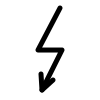
Triangle or bolt — 2 marks
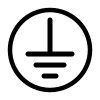
Earth lines — 3 marks

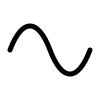
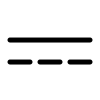
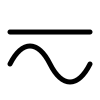
Wave or line — 3 marks
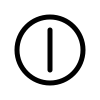
Power button — 4 marks


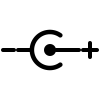
Dot in a C — 1 mark
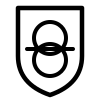
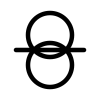
Two circles — 2 marks
Box with a line — 1 mark
Book — 1 mark

House: House outline

House outline (for indoor use only)
The equipment is designed primarily for indoor use. Use it indoors unless its manual says otherwise.
Symbol reference: IEC 60417-5957
- What it looks like
- The outline of a house with a pitched roof and a chimney on one side, and nothing inside it.
- Who may apply it
- The equipment maker, on electrical equipment it designed primarily for indoor use.
What it does not promise
It does not tell you how the item copes with water or dust. That is the job of an IP code such as IP44, which you can decode on our IP-code page. The symbol only says what the maker designed the item for.
- Wikimedia Commons: File page transcribing IEC 60417 entry 5957 (title, function, publication) — Symbol 5957 from IEC 60417, “For indoor use only”: to identify electrical equipment designed primarily for indoor use. Checked 2026-09-24.

On its own page: House outline (for indoor use only)
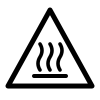
Triangle or bolt: Triangle with wavy lines
Same shape, with a page of its own: Lightning arrow.
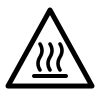
Triangle with wavy lines (caution, hot surface)
The marked part can be hot. Do not touch it without taking care.
Symbol reference: IEC 60417-5041
- What it looks like
- A triangle with three vertical wavy lines rising from a short line inside it.
- Who may apply it
- The equipment maker. The IEC entry lists it as referenced in many household-appliance safety standards (the IEC 60335-2 parts).
What it does not promise
It does not say how hot, or when. A part without the symbol can still be hot during and after use.
- Wikimedia Commons: File page transcribing IEC 60417 entry 5041 (title, function, notes) — Symbol 5041 from IEC 60417, “Caution, hot surface”: to indicate that the marked item can be hot and should not be touched without taking care. The inner symbol is ISO 7000-0535; warning signs are standardised in ISO 3864. Referenced in IEC 60335-2-6, 60335-2-9, 60335-2-11 and others. Checked 2026-09-24.

On its own page: Triangle with wavy lines (caution, hot surface)
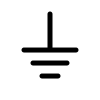
Earth lines: Earth (ground) sign
Same shape, with a page of its own: Protective earth · Functional earth.
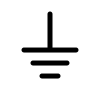
Earth (ground) sign
Marks an earth (ground) terminal in cases where neither the protective earth sign (5019) nor the functional earth sign (5018) is specifically required.
Symbol reference: IEC 60417-5017
- What it looks like
- A vertical line ending in three horizontal bars that get shorter towards the bottom, with no circle or arch round it.
- Who may apply it
- The equipment maker, on an earth terminal where neither the protective nor the functional earth symbol is specifically required.
What it does not promise
On its own it does not say whether the terminal gives shock protection or is only functional. The protective earth has its own sign, the earth in a circle, so check the manual before relying on this terminal for safety.
- Wikimedia Commons: File page transcribing IEC 60417 entry 5017 (title, function) — Symbol 5017 from IEC 60417, “Earth; ground”: to identify an earth (ground) terminal in cases where neither the symbol 5018 nor 5019 is explicitly required. Checked 2026-10-10.

On its own page: Earth (ground) sign
Wave or line: Solid line over a dashed line, Line over a wave
Same shape, with a page of its own: Sine wave.
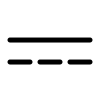
Solid line over a dashed line (direct current, DC)
On a rating plate: the equipment is suitable for direct current only. Next to a terminal or output: that terminal is for DC.
Symbol reference: IEC 60417-5031
- What it looks like
- A solid straight line with a dashed line (three short dashes) under it.
- Who may apply it
- The equipment maker, on the rating plate or terminals.
- Where it goes
- On rating plates and terminals.
What it does not promise
It gives no voltage, current or polarity. Match the output voltage, and check the polarity sign on barrel-plug supplies, before using a replacement power supply.
- Wikimedia Commons: File page transcribing IEC 60417 entry 5031 (title, function, publication) — Symbol 5031 from IEC 60417, “Direct current”: to indicate on the rating plate that the equipment is suitable for direct current only; to identify relevant terminals. Checked 2026-09-24.

On its own page: Solid line over a dashed line (direct current, DC)
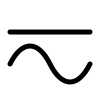
Line over a wave (both AC and DC)
The equipment is suitable for both direct and alternating current (universal). Next to a terminal, that terminal can take either.
Symbol reference: IEC 60417-5033
- What it looks like
- A straight line with a sine wave underneath it.
- Who may apply it
- The equipment maker, on the rating plate or terminals.
- Where it goes
- On rating plates and terminals.
What it does not promise
It does not mean any voltage is acceptable. The rated voltage range printed next to it still applies to both AC and DC.
- Wikimedia Commons: File page transcribing IEC 60417 entry 5033 (title, function, publication) — Symbol 5033 from IEC 60417, “Both direct and alternating current”: to indicate on the rating plate that the equipment is suitable for both direct and alternating current (universal); to identify relevant terminals. Checked 2026-09-24.

On its own page: Line over a wave (both AC and DC)
Power button: Vertical line, Circle
Same shape, with a page of its own: Broken circle with a line · Line inside a circle.

Vertical line (on, I)
On: the switch position that connects the equipment to the mains.
Symbol reference: IEC 60417-5007
- What it looks like
- A single short vertical line, usually on one end of a rocker switch and often read as “I”.
- Who may apply it
- The equipment maker, on mains switches or their positions, and in every case where safety is involved.
What it does not promise
It marks a switch position, nothing more. It says nothing about the voltage or the load. The IEC also notes that the symbol’s meaning depends on its orientation, so a horizontal line is not the on symbol.
- Wikimedia Commons: File page transcribing IEC 60417 entry 5007 (title, function, notes) — Symbol 5007 from IEC 60417, “ON” (power): to indicate connection to the mains, at least for mains switches or their positions, and all those cases where safety is involved; the meaning depends upon its orientation. Checked 2026-09-24.
- Unicode Consortium: Unicode Character Database, NamesList.txt — U+23FB to U+23FE and U+2B58 — U+23FD POWER ON SYMBOL; “use 2B58 for power off symbol”. Checked 2026-09-24.

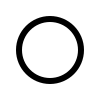
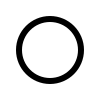
Circle (off, O)
Off: the switch position that disconnects the equipment from the mains, for mains switches and wherever safety is involved.
Symbol reference: IEC 60417-5008
- What it looks like
- A plain circle, usually on the other end of a rocker switch from the line, and often read as “O”.
- Who may apply it
- The equipment maker, on mains switches or their positions, and in every case where safety is involved.
What it does not promise
It shows what the switch is designed to do. It cannot tell you that the switch works.
- Wikimedia Commons: File page transcribing IEC 60417 entry 5008 (title, function, notes) — Symbol 5008 from IEC 60417, “OFF” (power): to indicate disconnection from the mains, at least for mains switches or their positions, and all those cases where safety is involved. Checked 2026-09-24.
- Unicode Consortium: Unicode Character Database, NamesList.txt — U+23FB to U+23FE and U+2B58 — U+2B58 HEAVY CIRCLE = power off symbol. Checked 2026-09-24.

On its own page: Circle (off, O)
Two circles: Two circles in a shield, Two overlapping circles
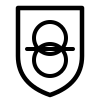
Two circles in a shield (safety isolating transformer)
The product is, or contains, a safety isolating transformer. The IEC lists it separately from the plain isolating transformer (5221), which has no shield outline.
Symbol reference: IEC 60417-5222
- What it looks like
- Two overlapping circles, one above the other and split by a horizontal line, inside a shield-shaped outline. A letter F next to it marks a fail-safe type.
- Who may apply it
- The transformer or power-supply maker. The IEC note allows the letter F beside the symbol to show a fail-safe function.
What it does not promise
It speaks for the transformer, not for the product plugged into it, and it gives no output voltage or power: read the rating printed beside it.
- Wikimedia Commons: File page transcribing IEC 60417 entry 5222 (title, function, notes) — Symbol 5222 from IEC 60417, “Safety isolating transformer, general”: to identify a safety isolating transformer; to indicate a fail-safe function, the letter F may be used adjacent to the symbol. Checked 2026-09-24.

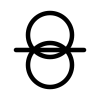
Two overlapping circles (isolating transformer)
The product is, or contains, a transformer of the isolation type: its output is electrically separated from its input.
Symbol reference: IEC 60417-5221
- What it looks like
- Two overlapping circles, one above the other, with a horizontal line through the middle and no shield around them.
- Who may apply it
- The transformer or power-supply maker. A letter F beside it marks a fail-safe type.
What it does not promise
Without the shield outline it is not the safety isolating transformer symbol (5222). It gives no output voltage or power: read the rating printed beside it.
- Wikimedia Commons: File page transcribing IEC 60417 entry 5221 (title, function, notes) — Symbol 5221 from IEC 60417, “Isolating transformer, general”: to identify a transformer of the isolation type; the letter F may be used adjacent to indicate a fail-safe function. Checked 2026-09-24.
- Wikimedia Commons: File page transcribing IEC 60417 entry 5222 (title, function, notes) — Symbol 5222 from IEC 60417 is the separate “Safety isolating transformer, general” and lists 5221 under “See also”. Checked 2026-09-24.

On its own page: Two overlapping circles (isolating transformer)
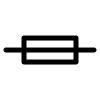
Box with a line: Fuse
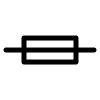
Fuse (box with a line through it)
Marks a fuse or where it sits, for example a fuse holder or a fuse box. Any rating printed beside the symbol belongs to that fuse.
Symbol reference: IEC 60417-5016
- What it looks like
- A narrow rectangle with a straight line running through it lengthways.
- Who may apply it
- The equipment maker, to identify a fuse box or where a fuse is located.
What it does not promise
The symbol alone does not give the rating or the speed of the fuse. Fuses are chosen to suit the load, and a time-delay (slow-blow) fuse is built to carry a brief surge that would blow a fast one, so a replacement should match what is printed beside the symbol or in the manual.
- Wikimedia Commons: File page transcribing IEC 60417 entry 5016 (title, function, publication) — Symbol 5016 from IEC 60417, “Fuse”: to identify fuse boxes or their location. Published in the first edition, 1973. Checked 2026-09-24.
- Wikipedia: Fuse (electrical) — “Fuse selection depends on the load's characteristics”; a time-delay (anti-surge or slow-blow) fuse is designed to let a current above its rating flow for a short time without blowing. Checked 2026-09-24.

On its own page: Fuse (box with a line through it)
IP44, IP67, IPX4?
An IP code is letters and digits, not a drawing: the first digit rates solids and touch, the second rates water. Type the code into the IP-code decoder →
A number like IEC 60417-5019 or ISO 7000-0790 in a manual or datasheet? Look up the symbol by its number →
Four things worth knowing
- Conformity marks are self-declarations. The CE marking is put on by the manufacturer, and for equipment under the Low Voltage Directive the manufacturer checks the product itself. A four-digit number beside the CE means a notified body took part. See CE marking.
- The double square means no earth is needed. Class II equipment relies on extra insulation instead. The UK HSE says to treat an item without it as Class I (earthed). See Class II.
- The crossed-out bin means separate collection, not your recycling bin. A bar under it means the product was placed on the market after 13 August 2005. See bin with a bar.
- Waves and lines. The sine wave on a rating plate means AC only. A solid line over a dashed line means DC only. A line over a wave means both.
What this page leaves out
- Certification and brand logos, such as UL, RCM, the USB logos or the Green Dot. They belong to the organisations that license them, so we do not draw them. Check them on their owners’ own sites.
- France’s Triman sorting logo is described in words on our recycling codes page. It is a logo, so we do not draw it here.
- Symbols without a public listing, for example the short-circuit-proof transformer variants. We only quote an IEC 60417 or ISO 7000 number when a public page lists it, and we leave out any mark whose meaning we could not source.
- It cannot tell you whether a particular product really meets what its marks declare. Only a test, the maker’s documents or a market-surveillance authority can.
Sources
Every page below was fetched and read on the date shown. Each mark page, and each mark explained above, lists what its sources say. Where a symbol’s IEC 60417 or ISO 7000 number is given, a public page listing that number is among them. Written in our own words; quotations are the sources’ wording.
- EUR-Lex (Official Journal of the EU): Regulation (EC) No 765/2008 — Article 30 and Annex II, the CE marking Checked 2026-09-24.
- EUR-Lex (Official Journal of the EU): Directive 2014/35/EU (Low Voltage Directive) — Article 1, Article 17 and Annex III Checked 2026-09-24.
- Your Europe (European Union): CE marking — obtaining the certificate, EU requirements Checked 2026-09-24.
- GOV.UK (Department for Business and Trade): Placing UKCA or CE marked products on the market in Great Britain (last updated 21 August 2026) Checked 2026-09-24.
- GOV.UK (Department for Business and Trade): Placing CE, or CE and UKNI marked products on the market in Northern Ireland (last updated 8 April 2026) Checked 2026-09-24.
- Wikimedia Commons: File page transcribing IEC 60417 entry 5172 (title, function, publication) Checked 2026-09-24.
- Health and Safety Executive (UK): INDG236 — Maintaining portable electrical equipment in low-risk environments (PDF) Checked 2026-09-24.
- US Occupational Safety and Health Administration: Letter of interpretation: marking recognition, regulations and policy of double insulated power tools (1985) Checked 2026-09-24.
- Wikimedia Commons: File page transcribing IEC 60417 entry 5180 (title, function, publication) Checked 2026-09-24.
- Wikimedia Commons: File page transcribing IEC 60417 entry 5019 (title, function, publication) Checked 2026-10-10.
- Wikimedia Commons: File page transcribing IEC 60417 entry 5018 (title, function, notes) Checked 2026-10-10.
- Wikipedia: Ground (electricity): functional grounds Checked 2026-10-10.
- Wikipedia: Earthing system: functional earthing (citing BS 7671 Part 2, definitions) Checked 2026-10-10.
- Schneider Electric: PowerLogic ION7400 product help: metering equipment symbols (IEC 61010-1) Checked 2026-10-10.
- Wikipedia: Appliance classes: Class II FE Checked 2026-10-10.
- Wikimedia Commons: File page transcribing IEC 60417 entry 5017 (title, function) Checked 2026-10-10.
- EUR-Lex (Official Journal of the EU): Directive 2012/19/EU on waste electrical and electronic equipment (WEEE) — Articles 14 and 15, Annex IX Checked 2026-09-24.
- Your Europe (European Union): WEEE — what does the label mean, EU requirements (page last checked by the EU 12/07/2026) Checked 2026-09-24.
- GOV.UK (Environment Agency): Electrical and electronic equipment (EEE) producer responsibility (last updated 12 August 2025) Checked 2026-09-24.
- EUR-Lex (Official Journal of the EU): Regulation (EU) 2023/1542 concerning batteries and waste batteries — Article 13 and Annex VI Checked 2026-09-24.
- EUR-Lex (Official Journal of the EU): Directive 2006/66/EC on batteries and accumulators (repealed from 18 August 2025) — Article 21 Checked 2026-09-24.
- Wikimedia Commons: File page transcribing IEC 60417 entry 5957 (title, function, publication) Checked 2026-09-24.
- Wikimedia Commons: File page transcribing IEC 60417 entry 5016 (title, function, publication) Checked 2026-09-24.
- Wikipedia: Fuse (electrical) Checked 2026-09-24.
- Wikimedia Commons: File page transcribing IEC 60417 entry 5032 (title, function, publication) Checked 2026-09-24.
- Wikimedia Commons: File page transcribing IEC 60417 entry 5031 (title, function, publication) Checked 2026-09-24.
- Wikimedia Commons: File page transcribing IEC 60417 entry 5033 (title, function, publication) Checked 2026-09-24.
- Wikimedia Commons: File page for the polarity symbol, IEC 60417 No. 5926 / JEITA CP-1104B No. 1030 Checked 2026-09-24.
- Wikipedia: Polarity symbols (the article itself flags that it lacks inline citations) Checked 2026-09-24.
- Wikipedia: DC connector Checked 2026-09-24.
- Wikimedia Commons: File page transcribing IEC 60417 entry 5222 (title, function, notes) Checked 2026-09-24.
- Wikimedia Commons: File page transcribing IEC 60417 entry 5221 (title, function, notes) Checked 2026-09-24.
- Wikimedia Commons: File page for ISO 7000 reference 0790, Read operator’s manual Checked 2026-09-24.
- Wikimedia Commons: File page transcribing ISO 7000 entry 1641 (title, function) Checked 2026-09-24.
- Wikimedia Commons: File page transcribing IEC 60417 entry 5036 (title, function, notes) Checked 2026-09-24.
- Wikimedia Commons: File page transcribing IEC 60417 entry 5041 (title, function, notes) Checked 2026-09-24.
- ENERGY STAR (US EPA): The External Power Supply International Efficiency Marking Protocol (the original 2005 version, PDF) Checked 2026-09-24.
- eCFR (US Government): 10 CFR 430.32(w) — energy conservation standards for external power supplies (current text read via the eCFR versioner API) Checked 2026-09-24.
- Wikimedia Commons: File page transcribing IEC 60417 entry 5009 (title, function, notes) Checked 2026-09-24.
- Wikipedia: Power symbol Checked 2026-09-24.
- Unicode Consortium: Unicode Character Database, NamesList.txt — U+23FB to U+23FE and U+2B58 Checked 2026-09-24.
- Wikimedia Commons: File page transcribing IEC 60417 entry 5007 (title, function, notes) Checked 2026-09-24.
- Wikimedia Commons: File page transcribing IEC 60417 entry 5008 (title, function, notes) Checked 2026-09-24.
- Wikimedia Commons: File page transcribing IEC 60417 entry 5010 (title, function) Checked 2026-09-24.


