What do the markings on a tyre mean?
Type the size from the sidewall (205/55 R16 91V) or the last four digits of the DOT code, and read it part by part. The tables come from UN Regulations No. 30 and 54 and US 49 CFR 574.5; nothing you type leaves this page.
What people ask
6 questions, each answered from its source: the size, 205/55 R16 · 91V · speed ratings · tyre age from the DOT code · the DOT identification number · the direction arrow
How do you read the size numbers on a car tyre? Left to right, as Michelin reads 205/55 R16: “205 means that your tyre is nominally 205 mm wide”, 55 means “the sidewall height, between the top of the tread and the rim, is 55% of the tyre width”, and “The letter, R, indicates that the tyre’s internal construction is Radial”. The last number is the wheel’s rim diameter in inches: in Pirelli’s 255/30 R19 example “the tyre is designed for 19-inch rims”. Read more: Tyre size.
Sources: Michelin (UK), Tyre markings explained: How to read a tyre? Checked 2026-10-13. · Pirelli (UK), Tyre Markings: Understanding Writing and Codes Checked 2026-10-13.
What does 91V mean on a tyre? They are two codes, not measurements. Michelin: the load index 91 “is a code which corresponds to a maximum load (in kg) that can be carried by a single tyre”, and the speed rating V “is a code which corresponds to the maximum speed at which a tyre can carry its maximum load”. Looked up in the UN Regulation No. 30 tables further down this page, 91 is 615 kg per tyre and V is 240 km/h. Read more: Load index · Speed rating.
Source: Michelin (UK), Tyre markings explained: How to read a tyre? Checked 2026-10-13.
How fast can a V-rated tyre go? The letter is looked up in a table for “the maximum speed that the tyre can safely withstand with a fully loaded vehicle”; Pirelli: “the letter V means that the tyre is rated for sustained speeds up to 149 miles per hour” (240 km/h). Winter tyres may be rated lower than the summer tyres they replace, and Michelin notes that then “a sticker showing this lower speed may be required inside the vehicle”. Read more: Speed rating.
Sources: Pirelli (UK), Tyre Markings: Understanding Writing and Codes Checked 2026-10-13. · Michelin (UK), Tyre markings explained: How to read a tyre? Checked 2026-10-13.
How do I tell how old a tyre is from the DOT code? Read the last four digits of the code that starts with DOT. Under 49 CFR 574.5 “The first and second symbols of the date code must identify the week of the year” and “The third and fourth symbols of the date code must identify the last two digits of the year of manufacture”, so Michelin’s example 4714 was made in week 47 of 2014. Michelin adds that this marking “only appears on one side of the tyre”, so look at the inner sidewall if the outer one has no four digits. Read more: DOT date code.
Sources: US National Highway Traffic Safety Administration, on eCFR, 49 CFR 574.5 — Tire identification requirements Checked 2026-10-13. · Michelin (UK), Tyre markings explained: How to read a tyre? Checked 2026-10-13.
What is the tyre identification number? It is the US tire identification number (TIN) after the letters DOT: 49 CFR 574.5 requires “a TIN consisting of 13 symbols”, starting with a three-symbol plant code that “represents the identity of the new tire manufacturer or retreader”, then a six-symbol manufacturer’s code, then the four-digit date code. The middle code is the maker’s own: it “may be used as a descriptive code for the purpose of identifying significant characteristics of the tire or to identify the brand name owner”, so only the maker can read it. Read more: DOT code · DOT date code.
Source: US National Highway Traffic Safety Administration, on eCFR, 49 CFR 574.5 — Tire identification requirements Checked 2026-10-13.
What does the arrow on a tyre sidewall mean? It marks a directional tyre, which Continental says “is designed to roll forward in one direction only”; the arrow on the sidewall is “in the same direction as the pattern, pointing in the required direction of travel”. Such tyres “can only be rotated vertically – for example, from the front of the car to the back”. Read more: Rotation arrow.
Source: Continental (UK), Tyre tread patterns and depth Checked 2026-10-13.
The questions are what people searched before landing here; each answer quotes only the regulation or tyre maker’s page named under it.
Or find a marking by its shape
Tap a shape — the markings that look like it appear here.
Numbers with a slash — 6 markings
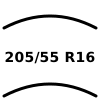 Tyre size (205/55 R16)Three numbers and a letter, the largest text near the rim after…
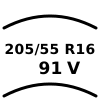 Load index (the 91 in 91V)A two- or three-digit number straight after the size, joined to a…
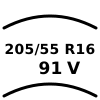 Speed rating (the V in 91V)One letter right after the load index: the V in 91V, the H in 91H,…
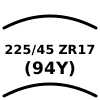 ZR in the size (225/45 ZR17) and (Y) in bracketsZR in place of R inside the size — 225/45 ZR17 94Y — and sometimes…
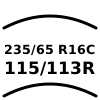 C, LT and CP: van, light-truck and camper tyres (235/65 R16C 115/113R)A C, LT or CP straight after the rim size (R16C, R16LT, R15CP), or…
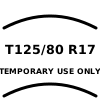 TEMPORARY USE ONLY and the T in T125/80 R17A narrow spare whose size starts with T (T125/80 R17 99M) and…
DOT and a long code — 3 markings
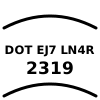 DOT date code (the last 4 digits, e.g. 2319)Four digits at the very end of the code that starts DOT, often in…
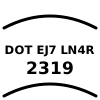 DOT tire identification number (DOT EJ7 LN4R 2319)The letters DOT followed by groups of letters and digits, 13…
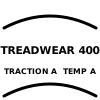 UTQG: TREADWEAR 400 TRACTION A TEMPERATURE AOn US passenger-car tyres, near the shoulder: TREADWEAR followed…
A word or a few letters — 10 markings
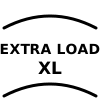 XL, Extra Load or ReinforcedXL after the size (225/45 R17 94Y XL), or the words EXTRA LOAD or…
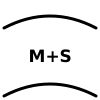 M+S (mud and snow)The letters M+S, M.S or M&S on the sidewall, often near the size;…
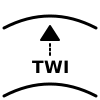 TWI and the tread-wear indicator triangleThe letters TWI, or a small triangle, on the shoulder where the…
 TUBELESS (or TL)The word TUBELESS on the sidewall, sometimes shortened to TL; its…
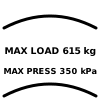 MAX LOAD and MAX PRESSSmall text near the rim, mainly on tyres sold in North America:…
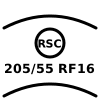 Run-flat markings (RF, RFT, ROF, SSR, ZP, RSC)An F in the size (205/55 RF16), and the maker’s own name for the…TEMPORARY USE ONLY and the T in T125/80 R17A narrow spare whose size starts with T (T125/80 R17 99M) and…
 OUTSIDE / INSIDE (asymmetric tyres)The word OUTSIDE on one sidewall and INSIDE on the other, on tyres…
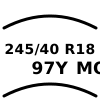 MO, MO1 and MOE for Mercedes-BenzThe letters MO moulded on the sidewall, alone or with more after…
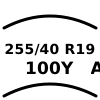 AO and AO1 for AudiThe letters AO moulded on the sidewall, alone or as AO1 or AO2;…
A letter in a circle — 2 markings
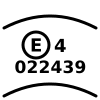
An arrow or a triangle — 2 markings

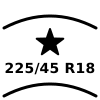
A star — 1 marking
How to read a sidewall
- The size and the service description are read left to right: 205 (section width, mm) / 55 (sidewall height as % of width) R (radial) 16 (rim, inches), then 91 (load index: 615 kg per tyre) V (speed symbol: 240 km/h). UN R30 Annex III gives the same reading for its own example, 185/70 R 14 89 T: 580 kg, 190 km/h, made in week 25 of 2003.
- Load and speed belong together: the load index is what the tyre carries at the speed its symbol allows. Above 210 km/h UN R30 cuts the load a V tyre may carry — to 91 % of the index value at 240 km/h — and W and Y tyres have their own tables (paragraph 2.31).
- The date code is only on one side on many tyres. In the US the full tyre identification number, with its date, must be on the intended outboard sidewall and the other side may carry it without the date (49 CFR 571.139, S5.5.1). If you cannot find four digits, look at the other side.
- The marks from the EU tyre label — fuel efficiency, wet grip, noise, snow and ice grip — are printed on the tyre label rather than moulded on the sidewall as grades; the mountain-and-snowflake is also moulded on the sidewall of severe-snow tyres (UN R117, 4.2.6). They have their own pages, linked below.
On the EU tyre label
The label sold with a tyre in the EU grades it for fuel efficiency, wet grip and noise, and shows snow and ice grip. Each mark has its own page:
Load index to kilograms
Indices 0–120 from UN Regulation No. 30, Annex IV; 121–200 from UN Regulation No. 54, Annex IV (which lists 60–200 and agrees with No. 30 on every index they share). The decoder reads the same table.
Show all 201 load indices
| Load index | kg per tyre |
|---|---|
| 0 | 45 |
| 1 | 46.2 |
| 2 | 47.5 |
| 3 | 48.7 |
| 4 | 50 |
| 5 | 51.5 |
| 6 | 53 |
| 7 | 54.5 |
| 8 | 56 |
| 9 | 58 |
| 10 | 60 |
| 11 | 61.5 |
| 12 | 63 |
| 13 | 65 |
| 14 | 67 |
| 15 | 69 |
| 16 | 71 |
| 17 | 73 |
| 18 | 75 |
| 19 | 77.5 |
| 20 | 80 |
| 21 | 82.5 |
| 22 | 85 |
| 23 | 87.5 |
| 24 | 90 |
| 25 | 92.5 |
| 26 | 95 |
| 27 | 97.5 |
| 28 | 100 |
| 29 | 103 |
| 30 | 106 |
| 31 | 109 |
| 32 | 112 |
| 33 | 115 |
| 34 | 118 |
| 35 | 121 |
| 36 | 125 |
| 37 | 128 |
| 38 | 132 |
| 39 | 136 |
| 40 | 140 |
| 41 | 145 |
| 42 | 150 |
| 43 | 155 |
| 44 | 160 |
| 45 | 165 |
| 46 | 170 |
| 47 | 175 |
| 48 | 180 |
| 49 | 185 |
| 50 | 190 |
| 51 | 195 |
| 52 | 200 |
| 53 | 206 |
| 54 | 212 |
| 55 | 218 |
| 56 | 224 |
| 57 | 230 |
| 58 | 236 |
| 59 | 243 |
| 60 | 250 |
| 61 | 257 |
| 62 | 265 |
| 63 | 272 |
| 64 | 280 |
| 65 | 290 |
| 66 | 300 |
| 67 | 307 |
| 68 | 315 |
| 69 | 325 |
| 70 | 335 |
| 71 | 345 |
| 72 | 355 |
| 73 | 365 |
| 74 | 375 |
| 75 | 387 |
| 76 | 400 |
| 77 | 412 |
| 78 | 425 |
| 79 | 437 |
| 80 | 450 |
| 81 | 462 |
| 82 | 475 |
| 83 | 487 |
| 84 | 500 |
| 85 | 515 |
| 86 | 530 |
| 87 | 545 |
| 88 | 560 |
| 89 | 580 |
| 90 | 600 |
| 91 | 615 |
| 92 | 630 |
| 93 | 650 |
| 94 | 670 |
| 95 | 690 |
| 96 | 710 |
| 97 | 730 |
| 98 | 750 |
| 99 | 775 |
| 100 | 800 |
| 101 | 825 |
| 102 | 850 |
| 103 | 875 |
| 104 | 900 |
| 105 | 925 |
| 106 | 950 |
| 107 | 975 |
| 108 | 1 000 |
| 109 | 1 030 |
| 110 | 1 060 |
| 111 | 1 090 |
| 112 | 1 120 |
| 113 | 1 150 |
| 114 | 1 180 |
| 115 | 1 215 |
| 116 | 1 250 |
| 117 | 1 285 |
| 118 | 1 320 |
| 119 | 1 360 |
| 120 | 1 400 |
| 121 | 1 450 |
| 122 | 1 500 |
| 123 | 1 550 |
| 124 | 1 600 |
| 125 | 1 650 |
| 126 | 1 700 |
| 127 | 1 750 |
| 128 | 1 800 |
| 129 | 1 850 |
| 130 | 1 900 |
| 131 | 1 950 |
| 132 | 2 000 |
| 133 | 2 060 |
| 134 | 2 120 |
| 135 | 2 180 |
| 136 | 2 240 |
| 137 | 2 300 |
| 138 | 2 360 |
| 139 | 2 430 |
| 140 | 2 500 |
| 141 | 2 575 |
| 142 | 2 650 |
| 143 | 2 725 |
| 144 | 2 800 |
| 145 | 2 900 |
| 146 | 3 000 |
| 147 | 3 075 |
| 148 | 3 150 |
| 149 | 3 250 |
| 150 | 3 350 |
| 151 | 3 450 |
| 152 | 3 550 |
| 153 | 3 650 |
| 154 | 3 750 |
| 155 | 3 875 |
| 156 | 4 000 |
| 157 | 4 125 |
| 158 | 4 250 |
| 159 | 4 375 |
| 160 | 4 500 |
| 161 | 4 625 |
| 162 | 4 750 |
| 163 | 4 875 |
| 164 | 5 000 |
| 165 | 5 150 |
| 166 | 5 300 |
| 167 | 5 450 |
| 168 | 5 600 |
| 169 | 5 800 |
| 170 | 6 000 |
| 171 | 6 150 |
| 172 | 6 300 |
| 173 | 6 500 |
| 174 | 6 700 |
| 175 | 6 900 |
| 176 | 7 100 |
| 177 | 7 300 |
| 178 | 7 500 |
| 179 | 7 750 |
| 180 | 8 000 |
| 181 | 8 250 |
| 182 | 8 500 |
| 183 | 8 750 |
| 184 | 9 000 |
| 185 | 9 250 |
| 186 | 9 500 |
| 187 | 9 750 |
| 188 | 10 000 |
| 189 | 10 300 |
| 190 | 10 600 |
| 191 | 10 900 |
| 192 | 11 200 |
| 193 | 11 500 |
| 194 | 11 800 |
| 195 | 12 150 |
| 196 | 12 500 |
| 197 | 12 850 |
| 198 | 13 200 |
| 199 | 13 600 |
| 200 | 14 000 |
Speed symbol to km/h
L–Y from UN Regulation No. 30, paragraph 2.29.1; F–K from UN Regulation No. 54, paragraph 2.28.2. H sits between U and V. ZR in the size marks a W or Y tyre; (Y) in brackets means above 300 km/h, with the actual maximum given by the maker.
| Symbol | km/h |
|---|---|
| F | 80 |
| G | 90 |
| J | 100 |
| K | 110 |
| L | 120 |
| M | 130 |
| N | 140 |
| P | 150 |
| Q | 160 |
| R | 170 |
| S | 180 |
| T | 190 |
| U | 200 |
| H | 210 |
| V | 240 |
| W | 270 |
| Y | 300 |
What these pages cannot do
- It reads the marking. It cannot tell you which size, load index or speed rating your car needs: that is on the vehicle’s tyre placard or in its handbook, and the vehicle maker is the authority.
- It does not say when to replace a tyre. UN R30 and 49 CFR 574.5 define the date code as the week and year of manufacture and set no age limit; some countries have their own rules for some vehicles, and tyre and vehicle makers publish their own advice.
- The size decoder reads metric sizes (205/55 R16 and the like), commercial C, LT and CP sizes and millimetre rim sizes. Older inch sizes such as 6.00-16 and flotation sizes such as 31x10.50R15 are listed in regulation tables of their own and are not decoded here.
- Left out: Three-peak mountain with snowflake (3PMSF, the Alpine symbol). It is the same drawing and the same UN R117 severe-snow test as the snow-grip mark on the EU tyre label, which already has its page at /energy-label/tyre-snow-grip/; the M+S page explains how the two differ.
- Left out: Regrooving symbol and REGROOVABLE. UN R54 (3.1.9) puts it on truck and bus tyres that may be regrooved; its drawing is not in the text we could read, and car and van tyres do not carry it.
- Left out: Rim-fitment letters A and U (185-560 R 400A). UN R30 Annex III defines them for tyre-and-rim systems that are rare on road cars; the size page mentions them and the decoder reads the millimetre rim size.
- Left out: Ply and cord material text (TREAD 2 POLYESTER + 2 STEEL …). US FMVSS 139 S5.5(e)–(f) requires it, but it is a plain description of the carcass, not a code, and does not change what you fit or how you use the tyre.
- Left out: Brand-specific car-maker marks (a star, MO, AO, N0 …). These mark tyres developed for, and approved by, one car maker. The tyre makers publish them, so a mark gets a page when two different tyre-maker groups’ own pages name it for the same car maker. Checked 2026-10-16 on the marking lists of Michelin, Pirelli and Continental; Goodyear/Dunlop, Bridgestone, Hankook and Yokohama were not read. Pages so far, chosen by what people search: the star for BMW, MO for Mercedes-Benz and AO for Audi. Confirmed by all three lists but with no page yet: N0, N1 and N2 for Porsche, T0 for Tesla, VOL for Volvo and LR for Land Rover; J for Jaguar is on Pirelli’s and Continental’s lists (Michelin writes JLR). Not confirmed by two groups, so left out: marks on one list only, such as Michelin’s K1–K3 for Ferrari (Pirelli lists F to F04 and Continental none), Pirelli’s B for Bentley and Pirelli’s AOE for Audi. Read: Star (★) for BMW and MINI · MO, MO1 and MOE for Mercedes-Benz · AO and AO1 for Audi.
Sources
Every document below was fetched and read on the date shown. Regulations are quoted by clause on each marking page; tyre makers are quoted only for markings that are their own practice or to show how they use a regulated one.
- UNECE, as published in the Official Journal of the EU: UN Regulation No. 30 — Uniform provisions concerning the approval of pneumatic tyres for motor vehicles and their trailers, Revision 3 (OJ L 201, 30.7.2008) — The car-tyre regulation: the size designation (2.17), speed categories (2.29.1), sidewall markings (3.1), the approval mark (5.4), tread-wear indicators (6.3) and the load-index table (Annex IV, indices 0–120). This is the 2008 consolidated text (Revision 3); later amendments exist, and unece.org holds the current text. Checked 2026-09-28.
- UNECE, as published in the Official Journal of the EU: UN Regulation No. 54 — Uniform provisions concerning the approval of pneumatic tyres for commercial vehicles and their trailers (OJ L 183, 11.7.2008) — The van and truck tyre regulation: speed categories F to H (2.28.2), single and dual load indices (2.27), the C, LT and CP suffixes (3.1.13, 3.1.14) and the load-index table (Annex IV, indices 60–200). Checked 2026-09-28.
- UNECE, as published in the Official Journal of the EU: UN Regulation No. 117 — Uniform provisions concerning the approval of tyres with regard to rolling sound emissions and/or to adhesion on wet surfaces and/or to rolling resistance (OJ L 218, 12.8.2016) — Defines the snow tyre and the snow tyre for use in severe snow conditions (the Alpine symbol), and the S, W and R suffixes after an approval number (5.3.2, 5.4.3). Checked 2026-09-28.
- US National Highway Traffic Safety Administration, on eCFR: 49 CFR 574.5 — Tire identification requirements — The DOT tire identification number (TIN): the plant code, the manufacturer’s code, the four-digit date code and what the DOT symbol certifies. Checked 2026-09-28.
- US National Highway Traffic Safety Administration, on eCFR: 49 CFR 571.139 — Standard No. 139, New pneumatic radial tires for light vehicles — US tyre markings (S5.5): the DOT symbol, the size, maximum permissible inflation pressure, maximum load rating, load range for LT tyres, tubeless, radial and the optional Alpine symbol; tread-wear indicators (S5.4); where the full TIN goes (S5.5.1). Checked 2026-09-28.
- US National Highway Traffic Safety Administration, on eCFR: 49 CFR 575.104 — Uniform tire quality grading standards — The TREADWEAR, TRACTION and TEMPERATURE grades moulded on US passenger-car tyres, and the explanation the regulation prints for buyers. Checked 2026-09-28.
- US National Highway Traffic Safety Administration, on eCFR: 49 CFR 571.110 — Standard No. 110, Tire selection and rims and motor home/recreation vehicle trailer load carrying capacity information — The vehicle placard (S4.3): where it is fixed and that it gives the vehicle maker’s recommended cold tyre pressures. Checked 2026-09-28.
- Michelin (UK): Tyre markings explained: How to read a tyre? — Michelin’s guide to sidewall markings: size, load index and speed rating, the letters P, LT, C, XL, HL and T, M+S and the three-peak mountain, Tubeless, MAX LOAD and MAX PRESS. Checked 2026-09-28.
- Michelin (UK): When to use reinforced tyres? — XL, the older REINF marking, SL, and the HL (High Load) class. Checked 2026-09-28.
- Michelin (UK): Runflat tyres help in the event of a puncture. What are they? — Michelin’s run-flat codes ZP and EMT and its conditions for fitting them. Checked 2026-09-28.
- Michelin (UK): Tyre rotation: extend the life of your tyres — Directional and asymmetric tyres: the arrow on the outer sidewall and the sidewall marked “Outside”. Checked 2026-09-28.
- Goodyear (UK): How To Read Your Tyre Sidewall Markings — Load index, speed rating, the letters TWI and the maximum inflation pressure. Checked 2026-09-28.
- Goodyear (UK): How To Rotate Your Tyres For Best Wear — Rotating directional tyres by following the arrows on the sidewall. Checked 2026-09-28.
- Pirelli (UK): Run Flat Tyres: What They Are and How to Identify Them — How to spot a run-flat tyre: Pirelli’s RSC in a circle and the acronyms RFT, SSR and ROF. Checked 2026-09-28.
- Pirelli (UK): Tyre Markings: Understanding Writing and Codes — The DOT code and its last four digits, M+S, TWI, maximum air pressure and load range. Checked 2026-09-28.
- Uniroyal (Continental group): Self Supporting Runflat (SSR) — SSR run-flat tyres and the letter F on the sidewall. Checked 2026-09-28.
- Continental (UK): Tyre tread patterns and depth — Directional and asymmetric tread patterns, the arrow on the sidewall, and tread wear indicators (TWI). Checked 2026-09-28.
- Michelin (UK): All you need to know about MICHELIN-developed marked tyres — What a marked tyre is, and Michelin’s OE marking table: the marks it moulds for each car maker, from AR (Alfa Romeo) to VOL (Volvo). Checked 2026-10-16.
- Pirelli (UK): Custom-made tyre marking — Why Pirelli makes marked tyres, and its Original Equipment marking list, car maker by car maker, from Alfa Romeo to Zeekr. Checked 2026-10-16.
- Continental (Singapore): Original Equipment — Manufacturer Tyre Markings — Continental’s OE key: each mark and the car maker it stands for, with a few labelled further (RUNFLAT, SILENT, VIANO). Checked 2026-10-16.