What does this symbol on my parcel mean?
Find it by its shape. 1. Pick what you see on the box. 2. Match it. 17 black handling symbols come from ISO 780:2015; 14 dangerous-goods marks and class labels come from the UN rules as applied in ADR 2025.
Tap a shape — the marks that use it appear here.
Two arrows pointing up — 2 marks


A wine glass — 1 mark

Umbrella, sun, thermometer, trefoil — 4 marks
 Keep away from rain (umbrella)Keep the box dry: do not leave it in the rain or on a wet floor.
 Keep away from sunlight (sun over a cover)Keep the box out of direct sunlight and away from heat.
 Protect from radioactive sources (trefoil over a cover)The contents could be spoiled by penetrating radiation: keep the…
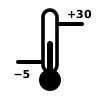 Temperature limits (thermometer)Keep the box between the two temperatures written by the mark, in…
Hook, trolley, forklift, clamp, chain — 6 marks
 Sling here (chain)Put the lifting slings (ropes, chains or straps of a crane) where…
 Use no hand hooks (crossed hook)Do not use hooks to handle this package.
 Do not use hand truck here (crossed trolley)Do not put the blade of a hand truck under this side of the package.
 Use no forks (crossed forklift)Do not lift or move this package with a forklift truck.
 Clamp as indicated (arrows pressing a box)A clamp truck may handle this package, gripping it on the sides…
 Do not clamp as indicated (crossed clamp)Do not grip the package with a clamp truck on the sides indicated.
A box: weight, n, cross or target — 5 marks
 Centre of gravity (target cross)The centre of the mark shows where the centre of gravity of the…
 Do not roll (crossed rolling arrows)Do not roll or tumble the package end over end to move it.
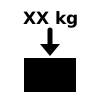 Stacking limit by mass (XX kg on a box)No more than the mass written may be stacked on top of this package.
 Stacking limit by number (n in a box)Identical packages may be stacked only up to the number written in…
 Do not stack (crossed box on top)Nothing may be stacked on top of this package.
A hatched border — 2 marks

Black-and-white diamond, no number — 2 marks


Coloured diamond with a number — 9 marks
 Class 1 label: explosives (orange diamond, bomb)The package contains explosives or articles containing them:…
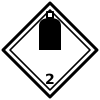 Class 2 labels: gases (red, green or white diamond)The package contains gas: compressed, liquefied, dissolved or…
 Class 3 label: flammable liquids (red diamond, flame)The package contains a flammable liquid: petrol, paint, varnish,…
 Class 4 labels: flammable solids (striped, half red or blue)The package contains a flammable solid (4.1: matches,…
 Class 5 labels: oxidisers and organic peroxides (yellow, or red and yellow)The package contains an oxidiser, which makes other things burn…
 Class 6 labels: toxic and infectious substances (white, skull or three crescents)The package contains a toxic substance (6.1: pesticides, some…
 Class 7 labels: radioactive material (trefoil, white or yellow)The package contains radioactive material, and the category says…
 Class 8 label: corrosive substances (white top, black bottom)The package contains a corrosive substance that destroys skin and…
 Class 9 label: miscellaneous dangerous goods, including the lithium battery label (black stripes)The package contains dangerous goods that fit no other class:…
Red-bordered diamond on the bottle — 9 marks
 Exploding bomb (GHS)On the product labelExplained on its own page →
 Flame (GHS)On the product labelExplained on its own page →
 Flame over circle (GHS)On the product labelExplained on its own page →
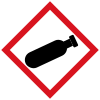 Gas cylinder (GHS)On the product labelExplained on its own page →
 Corrosion (GHS)On the product labelExplained on its own page →
 Skull and crossbones (GHS)On the product labelExplained on its own page →
 Exclamation mark (GHS)On the product labelExplained on its own page →
 Health hazard (GHS)On the product labelExplained on its own page →
 Environment (GHS)On the product labelExplained on its own page →
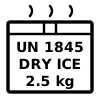
Orange “cargo aircraft only” or dry-ice wording — 2 marks

A hand in a triangle, “un” in a circle, or UN3373 — 3 marks
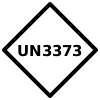 UN3373 — Biological substance, Category BThe box holds a Category B infectious substance — typically a…
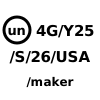 UN packaging code (“un” in a circle, e.g. 4G/Y25/S)The packaging is of a design type that passed the UN performance…
 ESD mark — hand in a triangle (electrostatic sensitive device)The contents are electronic parts that a spark of static…
Air-cargo marks
Two marks appear only because a parcel flies. Both are read from the US rules (49 CFR) and ICAO documents, each quoted on its page with the date it was checked.
More parcel marks
Three more marks people find on boxes: UN3373 — Biological substance, Category B, UN packaging code, ESD mark — hand in a triangle. Each page quotes the rule or standard that defines the mark, with the date it was checked.
UN3373 — Biological substance, Category BThe box holds a Category B infectious substance — typically a…UN packaging code (“un” in a circle, e.g. 4G/Y25/S)The packaging is of a design type that passed the UN performance…ESD mark — hand in a triangle (electrostatic sensitive device)The contents are electronic parts that a spark of static…Not yet published: the magnetised material label used in air cargo. It is defined in the IATA Dangerous Goods Regulations, a paid manual, and we found no official text we could open and quote, so we do not describe it here.
The four things people ask most
- Black marks are instructions, coloured diamonds are warnings. ISO 780 handling symbols are always black and never red, orange or yellow, so they cannot be confused with dangerous-goods labels (ISO 780:2015 clause 3.3). A coloured diamond with a number at the bottom is a transport hazard label. See this way up.
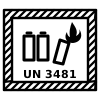
- The hatched rectangle with batteries and a UN number means small lithium or sodium ion batteries under ADR special provision 188: UN 3481 is lithium ion in or with equipment, UN 3480 loose. See the battery mark.
- The black-and-white diamond with no number is the limited-quantity mark: consumer-size dangerous goods such as perfume, aerosols or paint, in a box of at most 30 kg. See limited quantity mark.
- “Fragile” is a request, not a service. ISO 780 itself says the symbols give no guarantee of satisfactory handling; protective packaging comes first. See fragile, handle with care.
What this page does not cover
- Whether you may send it. These pages say what a mark means. What a carrier or postal service accepts — especially batteries, aerosols and anything by air — is set by its own terms and by the air rules (ICAO and IATA), which are stricter than road rules; apart from the two air-cargo marks above, the air rules are not covered here.
- Drawings for packing. Our drawings are for recognising a mark. Packers need the official figures, sizes and colours of ISO 780 and ADR 5.2.2.2.2.
- No “do not cut” symbol. ISO 780:2015 has 17 symbols and none of them means “do not cut” or “open here”; knife symbols on boxes are makers’ own marks.
- Supply labels. The red-bordered GHS pictograms on the bottle inside the box are supply labels, not transport labels; their tiles above link to hazard pictograms. Courier stickers, customs forms and pallet marks (ISPM 15) are out of scope.
Sources
Every document below was fetched and read on the date shown. ISO 780 is a paid standard, so its numbers and titles are read from ISO’s own preview pages and a symbol vendor’s list; UNECE did not answer scripted requests, so ADR sections are read through the UK regulator’s manual, a full quotation of ADR 2025 5.2.1.9, and the US rules that adopt the same marks. Each page lists what its sources show.
- Standard (preview pages) — ISO (preview pages published by iTeh Standards): ISO 780:2015 Packaging — Distribution packaging — Graphical symbols for handling and storage of packages, 5th edition 2015-12-01 (preview: foreword to Table 1) Checked 2026-09-27.
- Symbol list — IBJ / bravecroc (graphical-symbol file vendor): ISO 780 EN Symbols (2015-12): the 17 ISO 780:2015 symbols with their numbers and titles Checked 2026-09-27.
- Standard (preview pages) — ISO (preview pages published by iTeh Standards): ISO 780:1997 Packaging — Pictorial marking for handling of goods, 4th edition (preview: clause 2 and part of Table 1) Checked 2026-09-27.
- Regulator guidance — Health and Safety Executive (UK regulator for the carriage of dangerous goods): Carriage of dangerous goods manual — Consignment procedures: marking and labelling of packages (ADR 5.2) Checked 2026-09-27.
- Regulator guidance — Health and Safety Executive (UK regulator for the carriage of dangerous goods): Carriage of dangerous goods manual — Main exemptions: limited quantities (ADR 3.4) and excepted quantities (ADR 3.5) Checked 2026-09-27.
- Regulator guidance — Health and Safety Executive (UK regulator for the carriage of dangerous goods): Carriage of dangerous goods manual — Classification (environmentally hazardous substances, ADR 2.2.9.1.10 and 5.2.1.8) Checked 2026-09-27.
- Full quotation of the regulation — Tadiran Batteries GmbH, technical notice LTN-065-70-H: ADR 2025 — Transport regulations for road and rail transport, overview (quotes ADR 2025 special provision 188 and 5.2.1.9 in full) Checked 2026-09-27.
- Law adopting the same mark — US Government Publishing Office (govinfo), 49 CFR, edition of 1 October 2024: 49 CFR § 172.312 Liquid hazardous materials in non-bulk packagings (package orientation markings) Checked 2026-09-27.
- Law adopting the same mark — US Government Publishing Office (govinfo), 49 CFR, edition of 1 October 2024: 49 CFR § 172.315 Limited quantities (the limited quantity mark and the “Y” mark) Checked 2026-09-27.
- Law adopting the same mark — US Government Publishing Office (govinfo), 49 CFR, edition of 1 October 2024: 49 CFR § 173.4a Excepted quantities (with the excepted quantities mark) Checked 2026-09-27.
- Law adopting the same mark — US Government Publishing Office (govinfo), 49 CFR, edition of 1 October 2024: 49 CFR § 172.322 Marine pollutants (the fish-and-tree MARINE POLLUTANT mark) Checked 2026-09-27.
- Law adopting the same mark — US Government Publishing Office (govinfo), 49 CFR, edition of 1 October 2024: 49 CFR Part 172 Subpart E — Labeling (§§ 172.400–172.450, the hazard class labels) Checked 2026-09-27.
- Full quotation of the regulation — BAM, German Federal Institute for Materials Research and Testing (DGG-Info dangerous-goods database): DGG-Info Detailinfo, ADR 2025: the regulation text that applies to a listed substance (UN 3288), including ADR 2025 5.2.1.10 Orientation arrows in full Checked 2026-10-09.
- Regulation, official text — eCFR, Office of the Federal Register (US Code of Federal Regulations, current text): 49 CFR § 172.402 Additional labeling requirements — paragraph (c) Cargo Aircraft Only label Checked 2026-10-12.
- Regulation, official text — eCFR, Office of the Federal Register (US Code of Federal Regulations, current text): 49 CFR § 172.407 Label specifications — paragraph (c)(2), size of the CARGO AIRCRAFT ONLY label Checked 2026-10-12.
- Regulation, official text — eCFR, Office of the Federal Register (US Code of Federal Regulations, current text): 49 CFR § 172.448 CARGO AIRCRAFT ONLY label Checked 2026-10-12.
- ICAO document — ICAO Dangerous Goods Panel (DGP/26-WP/3, report and amendments to the Technical Instructions): DGP/26 report, Appendix B: amendments to the ICAO Technical Instructions including Packing Instruction 965 and the panel’s discussion of the cargo aircraft only label Checked 2026-10-12.
- ICAO document — ICAO (Doc 9284, Technical Instructions for the Safe Transport of Dangerous Goods by Air): Doc 9284-AN/905, 2015–2016 Edition, Addendum No. 4: UN 3480 lithium ion batteries made cargo aircraft only Checked 2026-10-12.
- Regulation, official text — eCFR, Office of the Federal Register (US Code of Federal Regulations, current text): 49 CFR § 173.217 Carbon dioxide, solid (dry ice) Checked 2026-10-12.
- Regulation, official text — eCFR, Office of the Federal Register (US Code of Federal Regulations, current text): 49 CFR § 172.101 Hazardous Materials Table — the entry “Carbon dioxide, solid or Dry ice”, UN1845, and the meaning of the column 1 symbols Checked 2026-10-12.
- Regulation, official text — eCFR, Office of the Federal Register (US Code of Federal Regulations, current text): 49 CFR § 172.301 General marking requirements for non-bulk packagings — paragraph (a)(1) Checked 2026-10-12.
- Regulation, official text — eCFR, Office of the Federal Register (US Code of Federal Regulations, current text): 49 CFR § 175.900 Handling requirements for carbon dioxide, solid (dry ice) Checked 2026-10-12.
- Regulation, official text — eCFR, Office of the Federal Register (US Code of Federal Regulations, current text): 49 CFR § 173.199 Category B infectious substances — the triple packaging, the UN3373 mark (paragraph (a)(5)) and the air limits Checked 2026-10-13.
- Regulation, official text — eCFR, Office of the Federal Register (US Code of Federal Regulations, current text): 49 CFR § 173.134 Class 6, Division 6.2 — definitions of Category A and Category B infectious substances Checked 2026-10-13.
- Regulation, official text — eCFR, Office of the Federal Register (US Code of Federal Regulations, current text): 49 CFR § 173.196 Category A infectious substances — the packaging and its § 178.503(f) marking Checked 2026-10-13.
- Regulation, official text — eCFR, Office of the Federal Register (US Code of Federal Regulations, current text): 49 CFR § 178.503 Marking of packagings — the UN specification marking, in order Checked 2026-10-13.
- Regulation, official text — eCFR, Office of the Federal Register (US Code of Federal Regulations, current text): 49 CFR § 178.502 Identification codes for packagings — what 1, 3, 4, A, G, H… mean Checked 2026-10-13.
- Standards body’s own explanation — EOS/ESD Association, Inc. (the standards developer of ANSI/ESD S8.1): ESD Fundamentals, Part 3: Basic ESD Control Procedures and Materials — section “Identification” (the ESD susceptibility and ESD protective symbols) Checked 2026-10-13.
- Standards body’s own explanation — EOS/ESD Association, Inc. (the standards developer of ANSI/ESD S8.1): ESD Fundamentals, Part 6: ESD Standards — the summary of ANSI/ESD S8.1 Symbols – ESD Awareness Checked 2026-10-13.