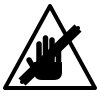
ESD mark — hand in a triangle (electrostatic sensitive device)
The contents are electronic parts that a spark of static electricity — often too small for you to feel — can damage. The crossed-out hand means “don’t touch without precautions”; the version with an arc means the bag or box itself is made to protect such parts.
Who puts it on the box
The maker or distributor of the electronic part, following the ESD Association’s standard ANSI/ESD S8.1, Symbols – ESD Awareness. It is an industry standard, not a transport regulation: no carrier or dangerous-goods rule requires it, and it does not make the parcel dangerous goods.
How to read it
Look at what crosses the hand. The ESD Association explains that the triangle means “caution” and the slash through the hand means “don’t touch”: the item may be damaged by electrostatic discharge if precautions are not taken, and whoever handles it should be grounded first. The arc instead of the slash is an “umbrella”: the item is ESD protective material — mats, wrist straps, garments, packaging. An international counterpart symbol is registered in IEC 60417, Graphical symbols for use on equipment, a paid database we could not open, so this page does not describe that version.
If the parcel is in your hands
Leave the part in its bag until you are ready to fit it: outside a static-controlled area the ESD Association expects packaging that shields against discharge. Before you take it out, ground yourself, for example with a grounded wrist strap at a workbench. The mark warns about damage to the part, not about a danger to you.
What it does not promise
It does not promise the part inside is undamaged — static damage can be invisible and show up later — and it does not promise the bag shields anything unless it is the protective (arc) version used as intended. It is not a dangerous-goods mark and says nothing about batteries or shipping restrictions.
A mark on a parcel is the sender’s statement about what is inside and how it should be handled. It is not a certificate that the parcel is packed safely, that anyone handled it as marked, or that your carrier accepts it: for what you may send, read the carrier’s own terms.
- What it looks like
- A triangle containing a reaching hand. With a slash through the hand it is the ESD susceptibility symbol; with an arc over the triangle instead of the slash it is the ESD protective symbol. You see the first on labels, components and boards, the second on the anti-static bags, foam and boxes they ship in. A sensitivity level may be printed beside the susceptibility symbol.
- Defined in
- ANSI/ESD S8.1, Symbols – ESD Awareness (ESD Association): the ESD susceptibility symbol and the ESD protective symbol, as explained in the Association’s ESD Fundamentals
- Kind of mark
- An industry handling symbol from the ESD Association standard ANSI/ESD S8.1, not a transport regulation. It warns about damage to the contents, never about danger to people or vehicles.
- Also called
- ESD symbol; Static sensitive device label; ESD susceptibility symbol; ESD protective symbol; Anti-static warning
What the rules say
The ESD Susceptibility Symbol (Figure 3) consists of a triangle, a reaching hand, and a slash through the reaching hand. The triangle means "caution" and the slash through the reaching hand means "Don't touch."
— ESD Fundamentals, Part 3: Basic ESD Control Procedures and Materials — section “Identification” (the ESD susceptibility and ESD protective symbols), EOS/ESD Association, Inc. (the standards developer of ANSI/ESD S8.1). Checked 2026-10-13.It indicates that handling or use of this item may result in damage from ESD if proper precautions are not taken. Operators should be grounded prior to handling.
— ESD Fundamentals, Part 3: Basic ESD Control Procedures and Materials — section “Identification” (the ESD susceptibility and ESD protective symbols), EOS/ESD Association, Inc. (the standards developer of ANSI/ESD S8.1). Checked 2026-10-13.The ESD Protective Symbol (Figure 4) consists of the reaching hand in the triangle. An arc around the triangle replaces the slash. This "umbrella" means protection.
— ESD Fundamentals, Part 3: Basic ESD Control Procedures and Materials — section “Identification” (the ESD susceptibility and ESD protective symbols), EOS/ESD Association, Inc. (the standards developer of ANSI/ESD S8.1). Checked 2026-10-13.The purpose of this document is to standardize commonly available and in-use symbols and to clarify the meaning of each of these symbols.
— ESD Fundamentals, Part 6: ESD Standards — the summary of ANSI/ESD S8.1 Symbols – ESD Awareness, EOS/ESD Association, Inc. (the standards developer of ANSI/ESD S8.1). Checked 2026-10-13.
Related
Other marks in this group
Sources
Each document was fetched and read on the date shown. Written in our own words; quotations are the documents’ wording.
- Standards body’s own explanation — EOS/ESD Association, Inc. (the standards developer of ANSI/ESD S8.1): ESD Fundamentals, Part 3: Basic ESD Control Procedures and Materials — section “Identification” (the ESD susceptibility and ESD protective symbols) — Section “Identification”: the ESD susceptibility symbol (triangle, reaching hand, slash; caution, don’t touch; applied to integrated circuits, boards and assemblies; operators grounded; sensitivity level may be added) and the ESD protective symbol (arc instead of slash; applied to mats, chairs, wrist straps, garments and packaging); section “Packaging”: discharge shielding outside a protected area. Checked 2026-10-13.
- Standards body’s own explanation — EOS/ESD Association, Inc. (the standards developer of ANSI/ESD S8.1): ESD Fundamentals, Part 6: ESD Standards — the summary of ANSI/ESD S8.1 Symbols – ESD Awareness — The summary of ANSI/ESD S8.1 Symbols – ESD Awareness: it standardises the symbols and separates “ESD susceptible” from “designed to afford some degree of ESD protection”. Checked 2026-10-13.