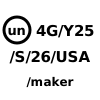
UN packaging code (“un” in a circle, e.g. 4G/Y25/S)
The packaging is of a design type that passed the UN performance tests for carrying dangerous goods. The code says what kind of packaging it is, which packing groups it was tested for, the weight or liquid density and pressure it was tested at, when it was made and which country authorised the mark.
Who puts it on the box
The packaging manufacturer, not the shipper: 49 CFR § 178.503(a) requires the manufacturer to mark every packaging represented as meeting a UN standard. A reconditioner adds its country, its name or symbol, the year, the letter R and, after a leakproofness test, the letter L. A drum or jerrican that will be reused or reconditioned must carry the first part of the marking in a permanent form, for example embossed.
How to read it
Worked example: 4G/Y25/S/26/USA. 4 is a box and G is fibreboard (§ 178.502; 1 is a drum, 3 a jerrican, 5 a bag, A steel, H plastic). Y means it passed the tests for packing groups II and III (X: I, II and III; Z: III only). 25 is the maximum gross mass in kilograms it was tested for. S means it is for solids or inner packagings. 26 is the year of manufacture, 2026. USA is the country that authorised the mark, followed by the maker. A drum for liquids reads differently, e.g. 1A1/Y1.4/150/26: a steel drum with a non-removable head, tested for a specific gravity of 1.4 and a hydrostatic pressure of 150 kPa. A box tested for infectious substances under § 178.609 reads like 4G/CLASS 6.2/26/USA: “CLASS 6.2” takes the place of the packing-group letter, mass and S, and that marking is the one Category A infectious substances need.
If the parcel is in your hands
If you are reusing a marked box to post something ordinary, the code does not matter. If you are shipping dangerous goods in it, check three things against the rules for your substance: the packaging type (the first code), that the letter covers your packing group (X covers all three), and that your gross weight or liquid density is within the tested figure. On plastic drums (1H) and plastic jerricans (3H) the month of manufacture is marked too, possibly away from the rest of the code.
What it does not promise
It does not promise that this particular box is in good condition, that it was closed the way it was tested, or that it suits every dangerous good: it certifies a design type, not your package. It does not say what is inside, and it is not a hazard warning.
A mark on a parcel is the sender’s statement about what is inside and how it should be handled. It is not a certificate that the parcel is packed safely, that anyone handled it as marked, or that your carrier accepts it: for what you may send, read the carrier’s own terms.
- What it looks like
- A small circle around the lowercase letters “un” (embossed metal may say “UN” instead), followed by a string of codes separated by slashes, on one line or several, for example 4G/Y25/S/26/USA/ and the maker’s name or registered symbol. It is usually printed in black on the side of a fibreboard box, or moulded or embossed into a drum or jerrican.
- Defined in
- 49 CFR § 178.503 (marking of packagings, the sequence of the UN marking, and paragraph (f) for infectious-substance packagings) and § 178.502 (identification codes), the US text of the UN Model Regulations packaging marking
- Kind of mark
- A packaging specification mark: the manufacturer’s statement that the design type passed the UN tests. The UN Model Regulations define it (packaging chapter 6.1) and countries adopt it — in the United States in 49 CFR Part 178. It certifies the container, not the contents.
- Also called
- UN specification marking; UN certified packaging code; UN box marking; 4G box code; UN packaging certification mark
What the rules say
A manufacturer must mark every packaging that is represented as manufactured to meet a UN standard with the marks specified in this section.
— 49 CFR § 178.503 Marking of packagings — the UN specification marking, in order, eCFR, Office of the Federal Register (US Code of Federal Regulations, current text). Checked 2026-10-13.A letter identifying the performance standard under which the packaging design type has been successfully tested, as follows: (i) X—for packagings meeting Packing Group I, II and III tests; (ii) Y—for packagings meeting Packing Group II and III tests; or (iii) Z—for packagings only meeting Packing Group III tests;
— 49 CFR § 178.503 Marking of packagings — the UN specification marking, in order, eCFR, Office of the Federal Register (US Code of Federal Regulations, current text). Checked 2026-10-13.For packagings intended to contain solids or inner packagings, the designation shall be the maximum gross mass in kilograms;
— 49 CFR § 178.503 Marking of packagings — the UN specification marking, in order, eCFR, Office of the Federal Register (US Code of Federal Regulations, current text). Checked 2026-10-13.A numeral indicating the kind of packaging, as follows: (i) “1” means a drum. (ii) “2” means a wooden barrel. (iii) “3” means a jerrican. (iv) “4” means a box. (v) “5” means a bag. (vi) “6” means a composite packaging. (vii) “7” means a pressure receptacle.
— 49 CFR § 178.502 Identification codes for packagings — what 1, 3, 4, A, G, H… mean, eCFR, Office of the Federal Register (US Code of Federal Regulations, current text). Checked 2026-10-13.An infectious substance packaging that successfully passes the tests conforming to the UN standard must be marked as follows:
— 49 CFR § 178.503 Marking of packagings — the UN specification marking, in order, eCFR, Office of the Federal Register (US Code of Federal Regulations, current text). Checked 2026-10-13.
Related
Other marks in this group

Sources
Each document was fetched and read on the date shown. Written in our own words; quotations are the documents’ wording.
- Regulation, official text — eCFR, Office of the Federal Register (US Code of Federal Regulations, current text): 49 CFR § 178.503 Marking of packagings — the UN specification marking, in order — Paragraph (a)(1)–(11): the UN symbol, packaging code, X/Y/Z, specific gravity or gross mass, test pressure or “S”, year, country, manufacturer and drum thickness, in that order, separated by slashes; (c) reconditioned packagings (R, L); (f) the CLASS 6.2 marking for infectious-substance packagings. Checked 2026-10-13.
- Regulation, official text — eCFR, Office of the Federal Register (US Code of Federal Regulations, current text): 49 CFR § 178.502 Identification codes for packagings — what 1, 3, 4, A, G, H… mean — Paragraph (a): the numeral for the kind of packaging (1 drum … 7 pressure receptacle), the capital letter for the material (A steel, B aluminium, C natural wood, D plywood, F reconstituted wood, G fibreboard, H plastic, L textile, M paper, N other metal, P glass), and the category numeral (1A1 non-removable head, 1A2 removable head). Checked 2026-10-13.