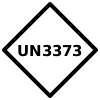
UN3373 — Biological substance, Category B
The box holds a Category B infectious substance — typically a patient or animal sample sent for diagnosis or research that may contain a germ, but not in a form that could cause permanent disability or life-threatening disease if it escaped. It travels as UN 3373 in a three-layer “triple” packaging.
Who puts it on the box
The person or laboratory that packs the sample. Under 49 CFR § 173.199 the mark goes on the outer packaging, the proper shipping name “Biological substances, Category B” goes next to it, and the name and telephone number of someone who knows about the material goes on the outer box or on the air waybill or bill of lading. The packaging maker must supply filling and closing instructions, and the packer must follow them.
How to read it
Read it as “Category B, not Category A”. Under § 173.134 an infectious substance is either Category A (UN2814, UN2900 or UN3549: capable of permanent disability or life-threatening disease in healthy people or animals) or Category B (UN3373: not in such a form, including samples sent for diagnosis). Category A packages carry the white class 6.2 infectious-substance label and must use UN-tested packaging marked “CLASS 6.2”; a UN3373 box carries neither. Medical waste is not UN3373: it is UN3291. By air, each inner container may hold at most 1 litre of liquid and each outer box at most 4 litres (or 4 kg of solids), not counting ice, dry ice or liquid nitrogen used as coolant.
If the parcel is in your hands
Do not open it: it is addressed to a laboratory. If it is wet, stained or crushed, do not handle the contents; set it aside, keep people away, and call the telephone number printed on the box or on the waybill — the rule requires one for exactly this. Airlines must inspect each UN3373 package for leakage when unloading it, and if it leaked the cargo hold must be disinfected. If you are sending a sample yourself, use the packaging you were given and follow its instructions to the letter: the box is part of a tested system that has to survive a 1.2 m drop without leaking.
What it does not promise
It does not promise the sample is harmless — it may contain a pathogen — and it does not promise it is dangerous: it says only that it is not Category A. It does not promise the box was packed correctly, and a UN3373 mark on its own says nothing about dry ice; a box cooled with dry ice must also be marked for it.
A mark on a parcel is the sender’s statement about what is inside and how it should be handled. It is not a certificate that the parcel is packed safely, that anyone handled it as marked, or that your carrier accepts it: for what you may send, read the carrier’s own terms.
- What it looks like
- A square standing on its point, black border on a contrasting background, with “UN3373” inside. Each side is at least 50 mm, the border line at least 2 mm and the characters at least 6 mm high; the words “Biological substances, Category B”, also at least 6 mm high, are printed next to the diamond. It is a mark, not a coloured hazard label: there is no class number at the bottom.
- Defined in
- 49 CFR § 173.199(a)(5) (the UN3373 mark and the shipping name), § 173.134(a)(1) (Category A and Category B) and § 173.196(a) (Category A packaging, for the contrast)
- Kind of mark
- A dangerous-goods mark for one entry of the UN list, UN 3373, which the US rules apply in 49 CFR § 173.199 on the pattern of the UN Model Regulations. Category B packages that follow that section are excepted from the other hazardous-materials rules, which is why the diamond replaces a class 6.2 label rather than sitting beside one.
- Also called
- UN 3373; Biological substance, Category B; UN3373 label; Diagnostic specimen label; Clinical specimen mark
What the rules say
The following square-on-point mark must be displayed on the outer packaging on a background of contrasting color. The width of the line forming the border must be at least 2 mm (0.08 inches) and the letters and numbers must be at least 6 mm (0.24 inches) high.
— 49 CFR § 173.199 Category B infectious substances — the triple packaging, the UN3373 mark (paragraph (a)(5)) and the air limits, eCFR, Office of the Federal Register (US Code of Federal Regulations, current text). Checked 2026-10-13.The proper shipping name “Biological substances, Category B” must be marked on the outer packaging adjacent to the diamond-shaped mark in letters that are at least 6 mm (0.24 inches) high.
— 49 CFR § 173.199 Category B infectious substances — the triple packaging, the UN3373 mark (paragraph (a)(5)) and the air limits, eCFR, Office of the Federal Register (US Code of Federal Regulations, current text). Checked 2026-10-13.A Category B infectious substance must be packaged in a triple packaging consisting of a primary receptacle, a secondary packaging, and a rigid outer packaging.
— 49 CFR § 173.199 Category B infectious substances — the triple packaging, the UN3373 mark (paragraph (a)(5)) and the air limits, eCFR, Office of the Federal Register (US Code of Federal Regulations, current text). Checked 2026-10-13.Category B: An infectious substance that is not in a form generally capable of causing permanent disability or life-threatening or fatal disease in otherwise healthy humans or animals when exposure to it occurs.
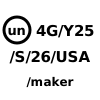
— 49 CFR § 173.134 Class 6, Division 6.2 — definitions of Category A and Category B infectious substances, eCFR, Office of the Federal Register (US Code of Federal Regulations, current text). Checked 2026-10-13.A packaging for a Division 6.2 material that is a Category A infectious substance must meet the test standards of § 178.609 of this subchapter and must be marked in conformance with § 178.503(f) of this subchapter.
— 49 CFR § 173.196 Category A infectious substances — the packaging and its § 178.503(f) marking, eCFR, Office of the Federal Register (US Code of Federal Regulations, current text). Checked 2026-10-13.
Related
Other marks in this group

Sources
Each document was fetched and read on the date shown. Written in our own words; quotations are the documents’ wording.
- Regulation, official text — eCFR, Office of the Federal Register (US Code of Federal Regulations, current text): 49 CFR § 173.199 Category B infectious substances — the triple packaging, the UN3373 mark (paragraph (a)(5)) and the air limits — Paragraph (a)(1)–(4) triple packaging and the 1.2 m drop test; (a)(5) the square-on-point mark: 50 mm sides, 2 mm border, 6 mm characters, the shipping name next to it, the whole mark on one side by air; (a)(7) the responsible person’s name and telephone number; (a)(8) leak inspection on unloading; (a)(10) packing instructions; (b)(5) and (c)(5) the 1 L, 4 L and 4 kg air limits. Checked 2026-10-13.
- Regulation, official text — eCFR, Office of the Federal Register (US Code of Federal Regulations, current text): 49 CFR § 173.134 Class 6, Division 6.2 — definitions of Category A and Category B infectious substances — Paragraph (a)(1): Division 6.2 defined; Category A (UN2814, UN2900, UN3549) and Category B (UN3373, “Biological substance, Category B”); regulated medical waste is UN3291. Checked 2026-10-13.
- Regulation, official text — eCFR, Office of the Federal Register (US Code of Federal Regulations, current text): 49 CFR § 173.196 Category A infectious substances — the packaging and its § 178.503(f) marking — Paragraph (a): Category A packaging must pass the § 178.609 tests and carry the § 178.503(f) marking; it is a triple packaging with an outer packaging of at least 100 mm. Checked 2026-10-13.