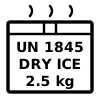
Dry ice marking (UN 1845, carbon dioxide, solid)
The parcel is kept cold with dry ice — solid carbon dioxide, UN 1845 — which gives off carbon dioxide gas. The weight shown is how much dry ice the shipper packed.
Who puts it on the box
The shipper. For air transport 49 CFR 173.217(c)(1) requires the net mass of the dry ice on the outside of the package, and (c)(2) requires the shipper to make arrangements with the airline for each shipment. A package with no more than 2.5 kg of dry ice used to cool its contents is excepted from the other requirements if it is marked “Carbon dioxide, solid” or “Dry ice”, with the name of what is being cooled and the net weight of dry ice (or a statement that it is 2.5 kg or less). By sea, packages are marked “CARBON DIOXIDE, SOLID—DO NOT STOW BELOW DECKS”.
How to read it
Read the figure as kilograms of dry ice at packing. In the US the rules apply to dry ice only by aircraft and by vessel: its table entry carries the symbols “A” and “W”, which mean subject to the rules only when transported by aircraft or by vessel. So a box that went only by road may carry no dry-ice marking at all. Frozen medical specimens cooled with dry ice can carry an extra marking saying the material is shipped for diagnostic or treatment purposes.
If the parcel is in your hands
Do not tape over the box’s gaps or put it inside an airtight bag or cooler with a sealed lid: the rules require packaging that lets the carbon dioxide gas out “to prevent a buildup of pressure that could rupture the packagings”. If you are sending dry ice by air yourself, mark the net mass on the box and agree it with the airline every time; the airline must tell its ground staff that dry ice is on board. This page does not cover handling dry ice with your hands — read the supplier’s safety information for that.
What it does not promise
It does not promise the contents are still frozen or that any dry ice is left: the weight is what was packed. It does not promise the box is safe to close tightly — it must never be sealed airtight — and it says nothing about the goods being cooled, which are often harmless food or medicine.
A mark on a parcel is the sender’s statement about what is inside and how it should be handled. It is not a certificate that the parcel is packed safely, that anyone handled it as marked, or that your carrier accepts it: for what you may send, read the carrier’s own terms.
- What it looks like
- Words, not a symbol: “Dry ice” or “Carbon dioxide, solid”, the net mass of the dry ice (for example “2.5 kg”), and on fully regulated air packages the number “UN1845” with the shipping name. The UN number must be at least 12 mm high, or 6 mm on packages of up to 30 kg. The US Hazardous Materials Table lists no hazard label for this entry (its label column reads “None”).
- Regulation
- 49 CFR § 173.217 (carbon dioxide, solid), the § 172.101 Hazardous Materials Table entry UN1845, § 172.301(a)(1) (size of the UN number) and § 175.900 (airline handling)
- Kind of mark
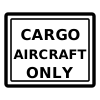
- An air-cargo mark: it applies when the package travels by aircraft, under the ICAO Technical Instructions and, in the United States, 49 CFR. It sits beside the dangerous-goods marks and labels rather than replacing them.
- Also called
- UN 1845; UN1845 dry ice label; Carbon dioxide, solid; Dry ice sticker
What the rules say
In addition to the applicable marking requirements in subpart D of part 172, the net mass of the carbon dioxide, solid (dry ice) must be marked on the outside of the package.
— 49 CFR § 173.217 Carbon dioxide, solid (dry ice), eCFR, Office of the Federal Register (US Code of Federal Regulations, current text). Checked 2026-10-12.Carbon dioxide, solid (dry ice), in quantities not exceeding 2.5 kg (5.5 pounds) per package and used as a refrigerant for the contents of the package is excepted from all other requirements of this subchapter if the requirements of paragraph (a) of this section are complied with and the package is marked “Carbon dioxide, solid” or “Dry ice”, is marked with the name of the contents being cooled, and is marked with the net weight of the dry ice or an indication that the net weight is 2.5 kg (5.5 pounds) or less.
— 49 CFR § 173.217 Carbon dioxide, solid (dry ice), eCFR, Office of the Federal Register (US Code of Federal Regulations, current text). Checked 2026-10-12.must be packed in packagings designed and constructed to permit the release of carbon dioxide gas to prevent a buildup of pressure that could rupture the packagings.
— 49 CFR § 173.217 Carbon dioxide, solid (dry ice), eCFR, Office of the Federal Register (US Code of Federal Regulations, current text). Checked 2026-10-12.The letter “A” denotes a material that is subject to the requirements of this subchapter only when offered or intended for transportation by aircraft, unless the material is a hazardous substance or a hazardous waste.
— 49 CFR § 172.101 Hazardous Materials Table — the entry “Carbon dioxide, solid or Dry ice”, UN1845, and the meaning of the column 1 symbols, eCFR, Office of the Federal Register (US Code of Federal Regulations, current text). Checked 2026-10-12.The identification number marking preceded by “UN”, “NA”, or “ID” as appropriate must be marked in characters at least 12 mm (0.47 inches) high.
— 49 CFR § 172.301 General marking requirements for non-bulk packagings — paragraph (a)(1), eCFR, Office of the Federal Register (US Code of Federal Regulations, current text). Checked 2026-10-12.The operator must ensure that the ground staff is informed that the dry ice is being loaded or is on board the aircraft.
— 49 CFR § 175.900 Handling requirements for carbon dioxide, solid (dry ice), eCFR, Office of the Federal Register (US Code of Federal Regulations, current text). Checked 2026-10-12.
Related
Other air-cargo marks
Sources
Each document was fetched and read on the date shown. Written in our own words; quotations are the documents’ wording.
- Regulation, official text — eCFR, Office of the Federal Register (US Code of Federal Regulations, current text): 49 CFR § 173.217 Carbon dioxide, solid (dry ice) — Paragraph (a) venting packaging; (b) the vessel markings “WARNING CO2 SOLID (DRY ICE)” on vehicles and containers and “CARBON DIOXIDE, SOLID—DO NOT STOW BELOW DECKS” on packages; (c)(1) net mass on the outside for air; (c)(2) arrangements with the operator; (c)(5) the 2.5 kg exception and its marking; (d) diagnostic and treatment specimens. Checked 2026-10-12.
- Regulation, official text — eCFR, Office of the Federal Register (US Code of Federal Regulations, current text): 49 CFR § 172.101 Hazardous Materials Table — the entry “Carbon dioxide, solid or Dry ice”, UN1845, and the meaning of the column 1 symbols — The table row “Carbon dioxide, solid or Dry ice”: symbols A and W, class 9, UN1845, label codes “None”; and paragraph (b) defining “A” (aircraft only) and “W” (vessel only). Checked 2026-10-12.
- Regulation, official text — eCFR, Office of the Federal Register (US Code of Federal Regulations, current text): 49 CFR § 172.301 General marking requirements for non-bulk packagings — paragraph (a)(1) — Paragraph (a)(1): proper shipping name and UN number on non-bulk packages, characters at least 12 mm high, or 6 mm on packages of 30 kg maximum net mass or less. Checked 2026-10-12.
- Regulation, official text — eCFR, Office of the Federal Register (US Code of Federal Regulations, current text): 49 CFR § 175.900 Handling requirements for carbon dioxide, solid (dry ice) — The airline must make suitable arrangements for dry ice based on aircraft type and ventilation, and must make sure ground staff are told that dry ice is being loaded or is on board. Checked 2026-10-12.