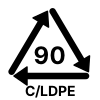
Code 90 (C/LDPE, C/PP)
The pack is plastic and aluminium bonded together so they cannot be separated by hand; Decision 97/129/EC numbers that composite 90. Composites are marked C/ plus the main material, so the letters follow the plastic: C/LDPE 90 or C/PE 90 on a polyethylene pouch, C/PP 90 on a polypropylene one.
- Material
- Plastic/aluminium
- Code
- Code 90 (C/LDPE, C/PP)
- Family
- Composites
- Defined by
- Commission Decision 97/129/EC
Which bin, usually
Usually the plastic packaging collection, where there is one: HSY sorts 90, 91 and 92 into collection for plastic packages because plastic is the main material. North London’s waste authority (NLWA) says it does not use material codes at all and asks you to look the item up in its A–Z instead. With no plastic packaging collection, it usually goes in general waste.
Source: HSY (Helsinki Region Environmental Services Authority): Recycling markings, checked 2026-10-16; North London Waste Authority: Plastics/aluminium - 90, checked 2026-10-16.
Whether this goes in your recycling depends on your local collection; check your council or municipality's sorting guide.
The material
Plastic/aluminium: plastic with a layer of aluminium bonded to it, so the two cannot be separated by hand.
Where you see it
HSY, the waste authority for Helsinki and its neighbouring cities, gives coffee packets as its example of a 90: the foil-lined packet ground coffee is sold in. The code itself names only the two materials, so any pack of plastic bonded to aluminium may carry it, and the pack is the only place to check.
Source: HSY (Helsinki Region Environmental Services Authority): Recycling markings, checked 2026-10-16.
What it does not mean
90 does not say which plastic: the letters after C/ do. It does not make the pouch aluminium either, so it does not go in with cans and foil trays (ALU 41), and a pouch marked 90 is not the same as plain LDPE 4 or PP 5 film.
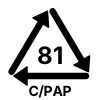
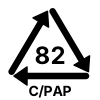
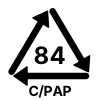
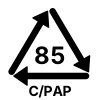
A composite code says the layers cannot be pulled apart by hand. It does not say that anyone near you separates them, and it does not mean the pack belongs with the material named after C/: C/PAP is not plain paper.
Annex VII also numbers 80 (Paper and fibreboard/miscellaneous metals), 83 (Paper and fibreboard/tinplate), 91 (Plastic/tinplate), 92 (Plastic/miscellaneous metals), 95 (Glass/plastic), 96 (Glass/aluminium), 97 (Glass/tinplate), 98 (Glass/miscellaneous metals).
Other ways it is printed
- 90 in a triangle of arrows with C/LDPE, C/PE, C/PP or C/PET under it
- C/LDPE 90, C/PE 90, C/PP 90 or 90 C/PP in plain text
- C/ALU 90 where the maker counts the aluminium as the main material
What this page cannot tell you
This page cannot tell you which bin your own collection uses: HSY’s advice is for the Helsinki region, NLWA’s for north London, and the Decision says nothing about bins at all. It cannot tell you how much of the pack is aluminium, because the code gives the materials, not their share. And many foil-lined pouches carry no code: without the number, the material cannot be read from the pack.
Other composites codes
Sources
- Commission Decision 97/129/EC of 28 January 1997 establishing the identification system for packaging materials (OJ L 50, 20.2.1997), as adopted — UK National Archives copy (Annex VII: Plastic/aluminium, 90; Article 2 definition of composite) — checked 2026-09-23
- Commission Decision 97/129/EC of 28 January 1997 establishing the identification system for packaging materials — EUR-Lex, the EU’s official text (Annex VII: Plastic/aluminium, 90) — checked 2026-10-16
- HSY (Helsinki Region Environmental Services Authority): Recycling markings (plastic-based composites) — checked 2026-10-16. It says: “These packages are sorted into collection for plastic packages. 90 (Plastic + aluminium): e.g. coffee packets”
- North London Waste Authority: Plastics/aluminium - 90 (Guidance) — checked 2026-10-16. It says: “we don't use material identification codes to decide if something can be recycled”
Written in our own words from these public texts and checked on the date shown. ASTM D7611 and ISO 14021 are sold by their publishers; only their public catalogue text is used here.