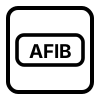
AFIB symbol (atrial fibrillation)
Does the AFIB symbol mean I have atrial fibrillation?
Both makers say their monitor does not diagnose it. Microlife: “Please note that the device is not intended to diagnose AF. A diagnosis of AF can only be confirmed by ECG.” Beurer (BM 53): “While the final diagnosis of atrial fibrillation can only be made by a medical examination, the Beurer AFIB technology of this device enables it to be detected with a high level of accuracy.”
The monitor’s built-in rhythm check found a pulse pattern that suggests atrial fibrillation (AF) during this one measurement. Microlife: “This symbol indicates that atrial fibrillation was detected during the measurement.” Beurer: “possible atrial fibrillation is detected and displayed after the measurement with the [AFIB] symbol in combination with the [cardiac arrhythmia] symbol.” Neither maker calls it a diagnosis, and only monitors sold with an AF check show it.
Check your monitor’s manual — makers differ.
What it is for
Both makers say to measure again first, and to see a doctor if the mark comes back. Microlife: “If the AFIB symbol appears after having performed a full blood pressure measurement, the patient is advised to perform another measurement.” If it shows again, Microlife writes: “we recommend the patient to seek medical advice.” Beurer (BM 53): “If the [AFIB] symbol is displayed after a blood pressure measurement, repeat the measurement.” Beurer continues: “If the [AFIB] symbol appears for the first time and more frequently, please promptly consult your doctor.” For people already diagnosed, Beurer says to “follow your doctor’s instructions regarding what to do in the event that AFIB is detected by the device.” Both manuals also warn that AF upsets the reading itself: Beurer writes that “the displayed blood pressure value may be incorrect”, Microlife that “the diastolic blood pressure value may not be accurate” and that “using MAM-mode is recommended for more reliable blood pressure measurement.”
These pages report what each maker’s manual says and quote it wherever health is involved. They do not diagnose anything and are not medical advice; only your own monitor’s manual describes your model.
- What it looks like
- The letters AFIB inside a small box, shown beside the reading once the measurement is over. Microlife’s BP B3 AFIB Advanced prints it directly above its PAD mark (a pulse line in a box); Beurer’s BM 53 prints it next to its cardiac arrhythmia mark (a heart with a pulse line). On both, the AFIB mark comes on together with that irregular-heartbeat mark, not instead of it.
- Names makers use
- Atrial Fibrillation Indicator (AFIB) (Microlife); AFib (Beurer)
Where makes differ
The drawing is the same on both; the names and the small print are not. Microlife calls it the “Atrial Fibrillation Indicator (AFIB)” and says its check works “in both standard mode and MAM mode”; it also says the device “may not or wrongly detect atrial fibrillation in people with pacemakers or defibrillators”, and “In pregnancy the AFIB symbol can be ignored.” Beurer lists it simply as “AFib” and says the display “can be influenced by factors such as heart disease, age, physical condition, over-stimulation, stress or lack of sleep”. Many monitors have no AF check at all: none of the seven other manuals this site read (Omron BP7250 and BP7450, A&D UA-611 and UA-651, Beurer BM 54 and BM 28, Withings BPM Connect) shows an AFIB mark, so those monitors show only the irregular-heartbeat mark. Omron sells AFib models in Europe, but omron-healthcare.com refused every request for their manuals on 2026-10-16, so Omron is not quoted here.
What it does not mean
It is not a diagnosis, in the makers’ own words: Microlife says “the device is not intended to diagnose AF” and that “The atrial fibrillation diagnosis however, must be made by a cardiologist based on ECG interpretation.” Beurer adds: “Do not perform self-diagnosis and self-treatment based on the measurements, but rather always follow the doctor’s instructions.” It is also not the same mark as the irregular heartbeat symbol. That mark (a heart with a pulse line, or Microlife’s PAD) only says the gaps between beats were uneven during the measurement, for any reason, arm movement included. The AFIB mark is narrower: it exists only on monitors with an AF check, and both makers show it on top of the irregular-heartbeat mark. Microlife: “When Atrial Fibrillation (AF) is detected, the PAD is also indicated because AF is one type of pulse irregularities.” So the irregular-heartbeat mark can appear on its own, but in these two manuals the AFIB mark never does.
Related
Sources
No published standard we could check defines blood pressure monitor control icons, so this meaning is taken from 2 makers’ own manuals and support pages, each fetched and read on the date shown:
- Microlife: Microlife — Instruction manual, BP B3 AFIB Advanced (PDF) — Display item 21, “Atrial Fibrillation Indicator (AFIB)”, drawn as the letters AFIB in a box: “This symbol indicates that atrial fibrillation was detected during the measurement.” Intended use: “Please note that the device is not intended to diagnose AF. A diagnosis of AF can only be confirmed by ECG.” Pulse arrhythmia section: “When Atrial Fibrillation (AF) is detected, the PAD is also indicated.” Checked 2026-10-16.
- Beurer: Beurer — Instructions for use, upper arm blood pressure monitor BM 53 (PDF) — Display list item “AFib”, drawn as the letters AFIB in a box. Section 6.4, Atrial fibrillation: “possible atrial fibrillation is detected and displayed after the measurement with the [AFIB] symbol in combination with the [cardiac arrhythmia] symbol”; “the final diagnosis of atrial fibrillation can only be made by a medical examination”; repeat the measurement, and consult a doctor if it appears “for the first time and more frequently”. Checked 2026-10-16.
Written in our own words; quotations are the makers’ wording.