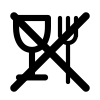
Crossed-out glass and fork (not for food contact)
Do not put food or drink in or on it. The item looks as if it could hold food — a pot, tub, bowl, plate or jar — but it is not meant for contact with food, and French rules require a visible, indelible marking on such look-alike items.
Set by French law
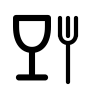
Not crossed out? See Glass and fork (for food contact).
Where the rule comes from
French law, not EU law. Regulation (EC) No 1935/2004 defines only the plain glass and fork (Article 15(1)(a) and Annex II); no EU law defines this crossed-out drawing. The French rule is article 2 of Décret n° 2007-766 of 10 May 2007, as amended: things that, despite how they look, are not meant to be used with food must carry a visible and indelible marking. The pictogram itself is set by an order (arrêté) of 28 January 1983, published in the Journal officiel of 25 February 1983, page 2143. The DGCCRF calls it a national measure that was notified to the EU, with a mutual-recognition clause.
- What it looks like
- The glass and fork of the food-contact mark — a stemmed wine glass beside a fork — struck through by an X. France’s consumer-fraud authority, the DGCCRF, describes it as ‘un verre et une fourchette barrés d’une croix’: a glass and a fork crossed out with a cross. It belongs on the item itself, visible and indelible, so look for it moulded into the base or printed on the side, not only on a removable label. Our drawing follows that description; we could not open the 1983 order’s own artwork.
- Other names
- crossed out glass and fork symbol; not food safe symbol (a name people search; the French rule speaks of items not meant for use with food); not for food contact symbol; pictogramme verre et fourchette barrés (French)
What it does not promise
It is a maker’s warning about intended use, not a test result. It does not say what the problem would be — a glaze, a paint, a metal, a plastic not made for food, or simply that nobody checked — and it does not say the item is dangerous to touch or to keep in the kitchen. It is also not a loophole: the DGCCRF says makers may not add it to escape the food-contact rules when the item can reasonably be expected to touch food, judged by its markings, shape, where and how it is sold; its examples are presentation plates and some decorative plates. And a missing mark does not make an item fit for food: look for the plain glass and fork, the words ‘for food contact’, or a use such as ‘soup spoon’.
Where makers differ
An earlier French decree (92-631 of 1992, Article 9) let the item carry either a statement that it cannot be put in contact with food or the conventional sign fixed by order, so the drawing is not the only lawful form; a printed line of text can do the same job. We could not open the 1983 order (Légifrance refuses our scripted fetches), so we cannot say how closely each maker’s version matches the official artwork, and we found no maker’s own symbol key that draws it. Outside France the EU regulation does not ask for any not-for-food mark, so on an item sold elsewhere the drawing is the maker’s own choice of warning.
Often confused with
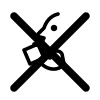
The sachet, pad or insert inside the pack is not food and must not be eaten. It marks ‘active and intelligent’ packaging parts, which absorb something from the pack (such as liquid or oxygen) or release something into it, whenever such a part could be mistaken for something edible.
More set by law symbols
Sources
The law comes first, then how makers and shops describe the mark. Each page was fetched and read on the date shown:
- DGCCRF (French consumer-fraud authority), economie.gouv.fr: Fiche générale relative à la réglementation des matériaux au contact des denrées alimentaires — ‘Dispositions nationales’ (Internet Archive copy of 21 February 2026) — The French authority’s general guide to food-contact rules. Under ‘Dispositions nationales’: ‘La réglementation française prévoit (article 2 du décret n° 2007-766 du 10 mai 2007 modifié) des dispositions visant à imposer un marquage visible et indélébile aux objets qui, malgré leur apparence, ne sont pas destinés à être utilisés au contact de denrées alimentaires. Le pictogramme, qui consiste en un verre et une fourchette barrés d’une croix, est disponible dans l’arrêté du 28 janvier 1983.’ It adds that operators may not use the mark to escape their obligations when an item falls under Regulation (EC) No 1935/2004, gives presentation plates and some decorative plates as examples, and calls it a notified national measure with a mutual-recognition clause. The live page on economie.gouv.fr refuses scripted fetches, so we read the Internet Archive’s copy of 21 February 2026. Checked 2026-10-09.
- Techniques de l’Ingénieur: Packaging law and practice — 7. Information: ‘Pictogram of unsuitability for food contact’ — A French engineering reference, section 7.1: ‘Mandatory information in France for objects which, by their appearance, appear to be intended for contact with foodstuffs, when in fact they are not suitable for contact with foodstuffs. The following symbol must be affixed visibly and indelibly (Decree 2007-766 of May 10, 2007, art. 2 and Order of January 28, 1983 published in the Journal officiel de la République française of February 25, 1983, page 2143).’ The figure itself is behind the publisher’s paywall. Checked 2026-10-09.
- FAOLEX (Food and Agriculture Organization of the United Nations): Décret n° 92-631 du 8 juillet 1992 relatif aux matériaux et objets destinés à entrer en contact avec les denrées … (France) — Article 9 — The earlier French decree, Article 9: objects ‘qui présentent l’apparence d’objets destinés à être mis au contact des denrées alimentaires mais qui ne répondent pas aux conditions fixées au présent décret doivent porter d’une manière visible et indélébile la mention qu’ils ne peuvent pas être mis au contact d’aliments ou une indication conventionnelle fixée par arrêté’ — the words, or a conventional sign fixed by order, telling buyers the objects must not be put in contact with food. Checked 2026-10-09.
- EUR-Lex (Official Journal of the European Union): Regulation (EC) No 1935/2004 on materials and articles intended to come into contact with food — Article 15 and Annex II — Article 15(1)(a): materials not yet in contact with food when sold shall be accompanied by ‘the words “for food contact”, or a specific indication as to their use, such as coffee machine, wine bottle, soup spoon, or the symbol reproduced in Annex II’. Annex II is the plain glass and fork; recital 17 says it came from Commission Directive 80/590/EEC. The regulation has no crossed-out or not-for-food version of the symbol. Checked 2026-10-09.
Written in our own words; quotations are the sources’ wording.